At a Glance
I run my whole house on Home Assistant with zero cloud dependency, and for years the last dumb thing on my walls was the light switches. Bulbs were smart, sensors were smart, the vacuum was local, but the switches just sat there cutting power to everything downstream. If you have ever had someone flip a wall switch and watched half your automations fall apart because the bulb lost power, you know exactly why this is the problem worth solving.
Zigbee wall switches fix it, and they do it the right way for a local setup: they mesh, they run without internet, and they report state straight into Home Assistant through Zigbee2MQTT or ZHA with no vendor account in the middle. I have installed all four of the switches below in my own house over the last couple of years, so this is a list of what actually lives in my walls, not a spec sheet roundup. This guide is part of my larger best Zigbee devices for Home Assistant coverage, focused specifically on the switch problem.
What makes a Zigbee switch good for Home Assistant
Before the picks, here is the frame I judged them against, because “smart switch” covers wildly different hardware.
First, does it need a neutral wire? This is the single question that eliminates half the market for a lot of houses. Older homes often wire switch boxes without a neutral, and a switch that demands one is simply not an option unless you want to open walls. Some switches solve this with a bypass module across the light fixture, others ship a dedicated no-neutral variant, and the cheap in-wall relays usually just require a neutral and are done with it.
Second, does it control a load or does it drive smart bulbs? If your ceiling has plain dumb bulbs, you want a switch that actually cuts and restores power to the fixture. If you have smart bulbs up there, cutting power is the worst thing you can do, because it drops those bulbs off the Zigbee mesh. The good switches let you decouple the paddle from the relay so a press sends a Zigbee event instead of killing the load.
Third, does it mesh? Mains-powered Zigbee switches act as routers, so every switch you add strengthens the network for your battery sensors. That is a quiet but real advantage over WiFi switches, which just add load to your access points and do nothing for range.
Fourth, is it honestly local? All four of these expose their entities directly to Zigbee2MQTT and ZHA. None of them phone home once they are paired to your own coordinator. If you are new to the coordinator side of this, my Zigbee coordinators guide covers the dongle you plug in to make any of this work.
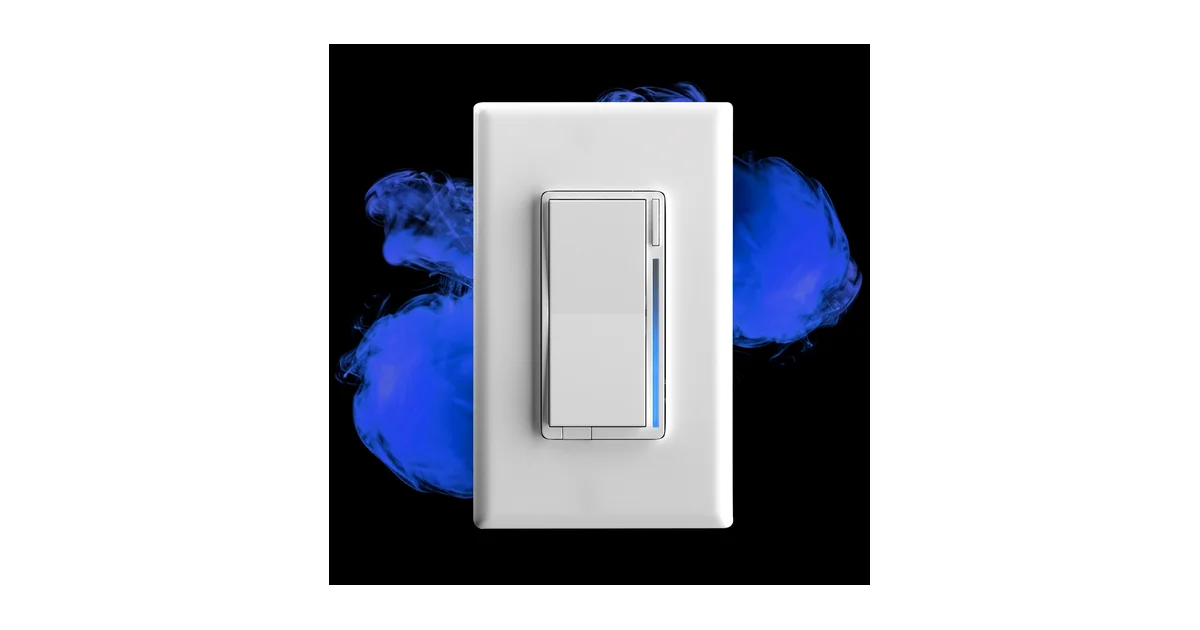
Inovelli Blue Series 2-1: the one to buy if you can
The Inovelli Blue Series 2-1 is the switch I recommend first, and it is not close for North American installs. It is a proper in-wall paddle switch that does on/off or dimming, it speaks Zigbee 3.0 straight into Home Assistant, and it packs a genuinely useful RGB LED bar down the side that you can drive from automations. I use that LED bar as an ambient status light: green when the garage is closed, a slow red pulse when a water leak sensor trips. That alone has replaced a couple of dashboard glances with a look at the hallway.
The killer feature for my house is smart bulb mode. Flip a config parameter and the switch stops cutting the load, keeps your smart bulbs powered, and turns every paddle press and multi-tap into a Zigbee scene event. So a single tap up runs your normal scene, a double tap up goes to full brightness, a triple tap runs something else entirely, all without the bulbs ever losing power. If you have spent money on Hue or other smart bulbs, this is the switch that finally makes the wall control sane.
The downsides are honest ones. It wants a neutral for full reliability, though you can run it no-neutral with a bypass across the fixture. It is deeper than a dumb switch, so a crowded box with fat wire nuts can be a tight fit. And at around $45 it is the priciest switch here. But it is UL listed, it is bulletproof once installed, and the community support is excellent. I wrote a full Inovelli Blue 2-1 review if you want the deep dive on parameters and wiring.
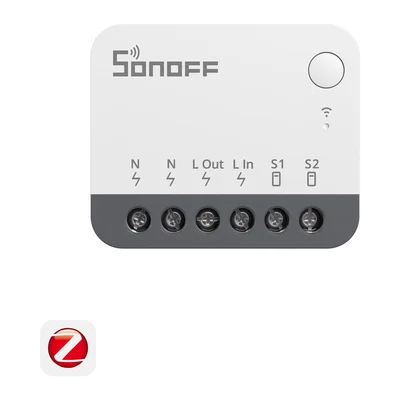
SONOFF ZBMINIR2: the cheapest way to make a whole house smart
If the Inovelli is the premium pick, the SONOFF ZBMINIR2 (also on Amazon) is how you make an entire house smart without wincing at the total. It is a tiny in-wall relay module, not a faceplate switch, so it hides behind your existing switch inside the box and keeps whatever paddle or toggle you already have. At single-digit dollars per unit, you can do a dozen switches for the price of a few Inovellis.
It is Zigbee 3.0, it pairs instantly in Zigbee2MQTT and ZHA, and it does one thing well: switch a load, locally, reliably. The R2 revision added a detach relay mode so you can decouple the physical switch input from the relay and use the switch as a Zigbee input for automations, which is the ZBMINIR2’s version of the smart bulb trick. It needs a neutral, which most modern boxes have, and it handles up to 10A resistive.
Because it is a SONOFF, I buy it direct from SONOFF with code JPK (also on Amazon) since the direct pricing usually beats Amazon and you are buying from the manufacturer. If you specifically have no neutral in your boxes, SONOFF’s ZBMINIL2 is the no-neutral sibling, which I covered in my no-neutral ZBMINIL2 writeup.
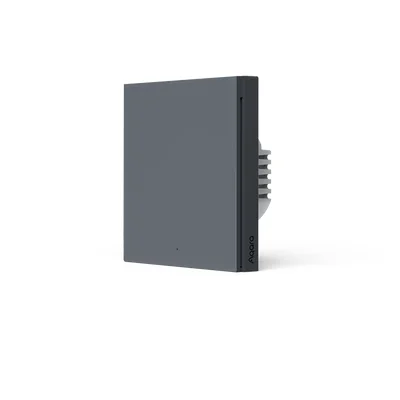
Aqara Smart Wall Switch H1: the clean no-neutral faceplate
The Aqara Smart Wall Switch H1 is the switch I reach for when I want a real faceplate on the wall, not a hidden relay, and the box has no neutral. Aqara ships an explicit no-neutral variant of the H1, which is the whole reason it earns a slot here: it solves the neutral problem without a bypass module and without opening walls. It looks clean, the build quality is a step above the budget options, and it supports a decoupled mode so you can drive smart bulbs or scenes instead of cutting the load.
The catch with Aqara is that you want to pair it directly to your own coordinator in Zigbee2MQTT or ZHA rather than through an Aqara hub. Aqara devices have a reputation for being fussy on third-party coordinators, and I have hit the occasional dropped device on a weak mesh. In practice, with a decent coordinator and a couple of router devices nearby, the H1 has been stable for me. Just do not expect the plug-and-forget experience of the SONOFF; budget a little pairing patience.
Physically it is a European-style faceplate, so it fits square wall boxes better than standard US decora openings. If your boxes are US decora, the Inovelli is the better mechanical fit. But for no-neutral rooms where I want a proper switch on the wall, the H1 is the one I use.
Third Reality Smart Switch Gen3: the renter special
The Third Reality Smart Switch Gen3 is the odd one out, and it is here because it solves a problem none of the others touch: no wiring at all. Instead of replacing your switch, it is a battery-powered Zigbee actuator that physically mounts over your existing toggle or rocker and mechanically flips it. You do not open the box, you do not touch a wire, and when you move out you peel it off.
That makes it the pick for renters, for circuits you are nervous about, and for anyone who just does not want to do electrical work. It pairs into Home Assistant over Zigbee like everything else, and you get on/off plus scheduling through your own automations. The tradeoffs are exactly what you would expect from a motor flipping a switch: it is slower than a relay, it makes a small mechanical clunk, and it runs on batteries you will eventually replace. It also cannot dim.
But for what it is, it works, and it is the only switch on this list you can install in sixty seconds with zero risk. I keep a couple around for exactly that reason.
The Bottom Line
If you can do the wiring and you are in North America, buy the Inovelli Blue Series 2-1. It is the most capable switch here, the smart bulb mode and LED bar are genuinely useful, and it is the one I put in the rooms that matter most. If you are wiring a whole house on a budget, the SONOFF ZBMINIR2 (also on Amazon) makes every switch smart for pocket change and never phones home. If your boxes have no neutral and you want a real faceplate, the Aqara H1 is the clean answer. And if you rent or refuse to touch a wire, the Third Reality Gen3 sticks over your existing switch and just works.
All four run fully local through Zigbee2MQTT or ZHA with no cloud, which is the whole reason to build on Home Assistant in the first place. Pick the one that matches your walls and your comfort with a screwdriver, pair it to your own coordinator, and get the last dumb thing off your wall.