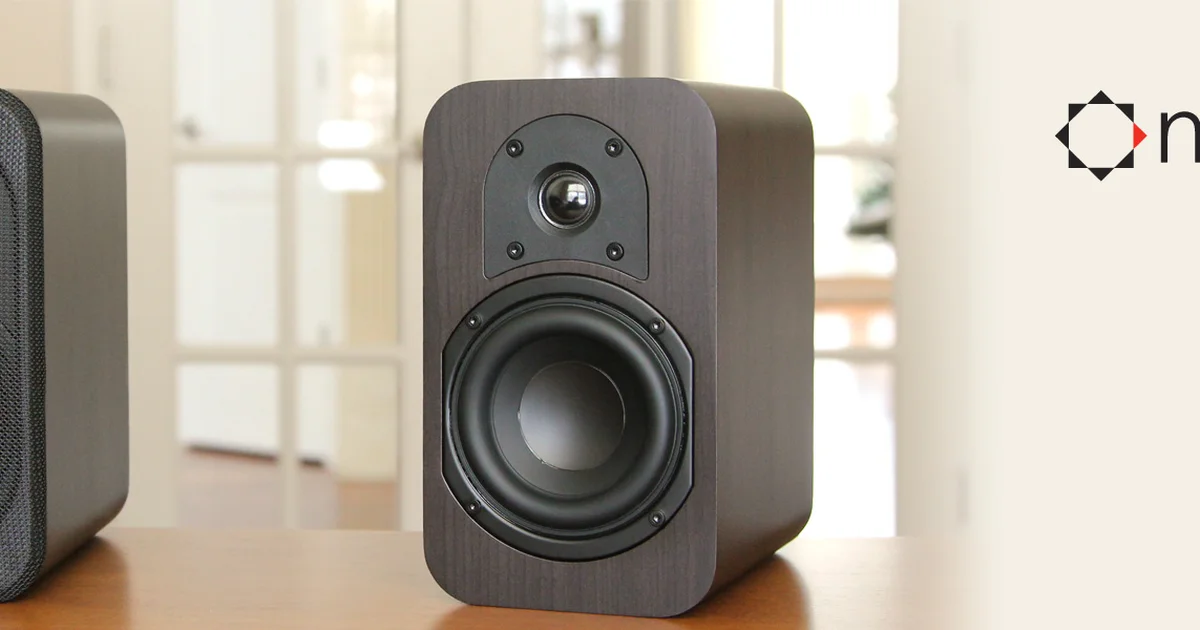
Every so often a piece of budget audio gear develops a reputation that outruns its price tag, and then you spend months wondering whether the internet is right or just loud. The Micca RB42 is one of those. For years it has been the answer people give when someone asks for a real hi-fi bookshelf speaker under $200, and I finally put a pair on my desk and lived with them long enough to find out whether the hype holds. It does, mostly, with the honest caveats that any $150 speaker deserves.
The RB42 is a passive two-way bookshelf speaker, which means it has no amplifier inside. You bring the amp, run speaker wire to the binding posts, and feed it a source. That is the first thing to understand about it and the first thing people get wrong.
What You Actually Get for $150
Pick one up and the first surprise is the weight. Each cabinet is around eight pounds, dense and well braced, with a real MDF enclosure and a walnut vinyl wrap that looks far more expensive than it is. Next to the flimsy plastic-bodied speakers that usually live at this price, the RB42 feels like a mistake in your favor. Micca clearly spent the budget on the box and the drivers and almost nothing on marketing, which is exactly the trade you want.
Inside is a 4-inch long-throw woofer paired with a 0.75-inch silk-dome tweeter, in a ported cabinet that Micca voiced for output rather than for measurement-chart flatness. The binding posts on the back are real five-way posts, not spring clips, so you can use banana plugs or bare wire. At around $149 for the pair, this is a legitimately over-built little speaker, and you feel that before you have played a single note.
The Sound: Bass You Do Not Expect
The RB42’s whole reputation rests on one trick, and the trick is real. A 4-inch woofer has no business producing the kind of low-end this speaker does. Micca tuned the port and the driver for a full, warm bottom octave that makes the RB42 sound bigger than its size and price suggest. On a desk, near-field, with your ears a couple of feet away, it produces bass you can feel a little of, not just hear. I ran it for weeks without a subwoofer and rarely wished for one at desktop distance.
That output comes with a voicing choice. The RB42 is warm and smooth, not clinical and analytical. The midrange is rich, vocals are full-bodied, and the top end is polite rather than sparkling. If you feed it a bright or badly mastered recording, the RB42 forgives it instead of exposing it. Some listeners will call that a slightly rolled-off, dark presentation, and they are not wrong. What it buys you is a speaker that is genuinely easy to listen to for hours and that makes cheap gear and rough streams sound good, which at this price is exactly the right priority.
Where it gives ground is in the last measure of air and micro-detail. A speaker two or three times the price will pull more space and shimmer out of a good recording. The RB42 trades some of that top-end resolution for its smoothness. For desktop and small-room listening, background music, and movies, I never missed it. For critical, lean-forward listening on well-recorded acoustic material, you can hear the ceiling.
You Must Budget for an Amplifier
This is the part people skip and then leave a confused review about. The RB42 is passive. It needs an amplifier, and because its sensitivity is a low-ish 85dB, it wants a bit of real power to open up. This is not a knock, it is just physics, and the good news is that the modern class-D amp market makes this a solved and cheap problem.
I ran mine off a Fosi Audio ZA3, a compact class-D amp that costs around $100 and has far more clean power than a pair of RB42s will ever need. That combination, roughly $150 in speakers and $100 in amp, gets you a complete two-channel desktop system for about $250 that genuinely competes with powered speakers costing more. Any competent budget amp works; you do not need to spend big here. But you do need to spend something, so factor the amp into your budget before you decide the RB42 is the cheap option. It is the cheap option only if you already have an amp or account for one.
Run decent 16 AWG speaker wire to the binding posts and you are done. There is nothing exotic about wiring these up.
Living With Them Day to Day
Specs and first impressions are one thing; what matters is whether a speaker is still a pleasure after a few months, and the RB42 is. On my desk it drives everything from morning podcasts to late-night records without ever becoming fatiguing, and that warm voicing is the reason. Bright speakers sound impressive for twenty minutes and then wear you down over a workday. The RB42 does the opposite. It disappears into the background when you want it to and pulls forward when you turn it up.
For a two-person desk-plus-TV setup I found it happiest with a source feeding the amp over a simple analog or DAC connection, and it paired well with a small WiiM streamer when I wanted app control and multi-room grouping. That is the RB42’s quiet strength: because it is passive, you choose the brains of the system, and you can upgrade the amp, the DAC, or the streamer independently over time without throwing the speakers away. A powered speaker locks all of that inside one box. The RB42 lets the system grow.
The one habit worth building is giving them a proper break-in. Straight out of the box the bass is a touch stiff and the top end slightly closed. After twenty or thirty hours of real playback the woofer surround loosens and the sound opens up noticeably. Do not judge them on day one.
Placement and the Small-Room Truth
The RB42 is a near-field and small-room speaker, and it is honest to say so. On a desk, a couple of feet from your ears, it is superb, and the warm tuning that would be too much across a large living room is exactly right up close. On a small bookshelf or in a bedroom system it also shines. What it will not do is fill a big open-plan room. Two 4-inch woofers can only move so much air, and asking them to pressurize a 20-foot space is asking the wrong speaker the wrong question.
A little care with placement pays off. Because the port does real work, give the cabinets a few inches of breathing room from the wall or the bass gets boomy and one-note. A cheap pair of desktop isolation stands to angle them up toward your ears and decouple them from the desk tightens things up noticeably. Toe them in so the tweeters aim at your head. None of this is fussy, but the RB42 rewards a few minutes of setup more than most cheap speakers do.
If your room is large or you want these to be the main speakers for a whole living room rather than a desk, look at bigger passive options in my best passive bookshelf speakers under $500 guide, where the RB42 earns its spot but where more room-filling choices also live.
How It Compares
At its price the RB42 does not have many real rivals, which is part of why it is recommended so relentlessly. The powered desktop speakers people cross-shop it against, like the Edifier MR4, are more convenient because they include an amp and inputs, but they cannot match the RB42’s cabinet quality or the sheer weight of its low end. The trade is real: the MR4 is plug-and-play, the RB42 needs an amp but rewards you with better sound.
Step up to something like the ELAC Debut B6.2 or the Q Acoustics 3030i and you get more resolution, more air, and more room-filling ability, but you also roughly double or triple the price. The RB42’s argument is not that it beats those speakers. It is that it gets you 80 percent of the way there for a third of the money, and for a desk that last 20 percent barely matters.
The Bottom Line
The Micca RB42 earned its reputation. It is a genuinely over-built little passive speaker that produces bass no 4-inch woofer should, wrapped in a cabinet that shames its price, voiced to be easy and enjoyable rather than clinical. Pair it with a cheap class-D amp and you have a complete desktop or small-room hi-fi system for around $250 that embarrasses a lot of pricier powered speakers.
Just go in with clear eyes. Budget for the amp, because it is passive. Keep it near-field or in a small room, because that is where it belongs. Accept the warm, forgiving tuning as a feature, because that is what it is. Do that and the RB42 is the easiest budget-audio recommendation I make. It is the passive bookshelf speaker I hand anyone who wants real hi-fi bass on a desk without spending real hi-fi money.