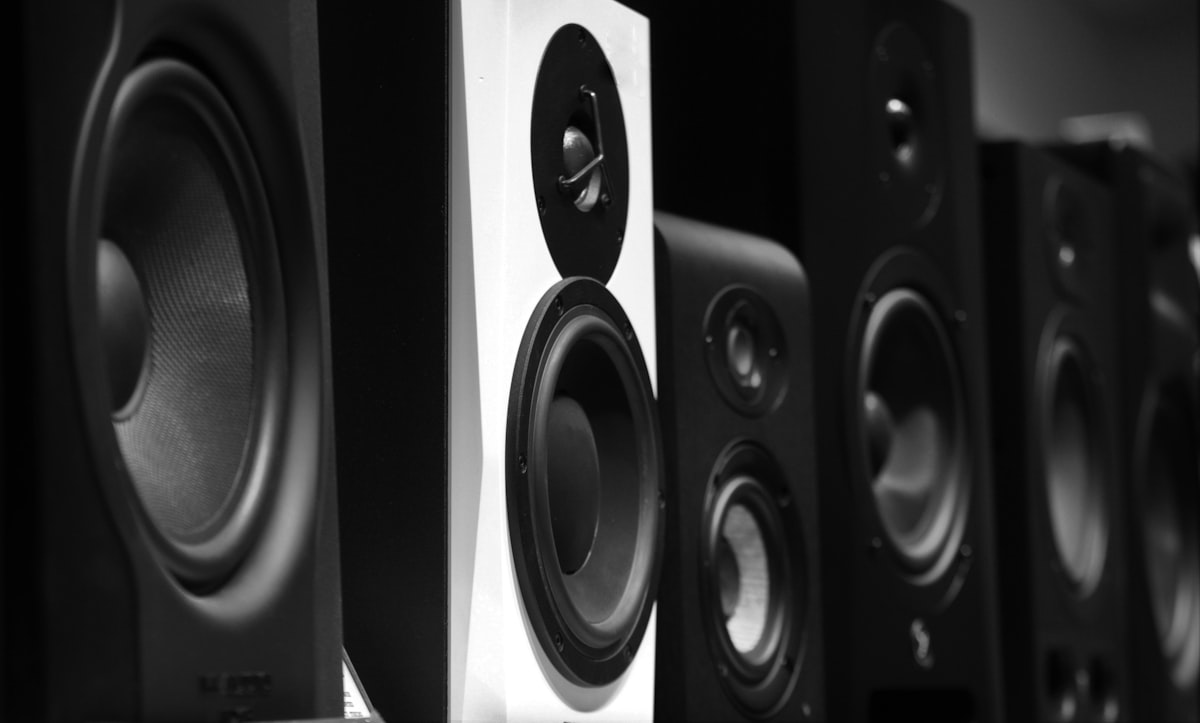
If you’ve been reading this site for any length of time you know I have a problem: I keep recommending two bookshelf speakers in the same sentence. The ELAC Debut 3.0 DB63 and the Q Acoustics 3030i both show up in every “best under $500” post I write, and people email me asking which one to actually buy.
Fair question. Here is the actual answer.
The Quick Verdict
Both of these speakers are genuinely excellent and you would not regret either choice. They’re also legitimately different from each other in ways that matter. If you skip to the bottom:
- Buy the ELAC DB63 (~$280/pair) if you want neutral, well-mannered speakers that work in tight placements (front-ported), save you ~$220, and pair with a small amp for a near-flagship sound on a budget.
- Buy the Q Acoustics 3030i (~$500/pair) if you want a wider, more dimensional soundstage, slightly more authoritative bass, and a more upmarket cabinet — and you can give them a couple of feet to breathe behind the speaker.
The rest of this post is about why.
Cabinet and Build
The 3030i is a bigger, heavier speaker. 25cm cabinet depth versus the DB63’s 24cm, slightly more internal volume, and a noticeably nicer cabinet finish. The vinyl wrap on the 3030i is convincingly woodgrain; the DB63’s vinyl is a tier below — it looks fine, but you can tell it’s wrap-on-MDF if you look. Internal bracing in both is competent for the price.
The 3030i is rear-ported. The DB63 is front-ported. This is the single most important practical difference and I’ll come back to it.
Both come with magnetically-attached grilles, both have good binding posts (single set on the DB63, single set on the 3030i — neither bi-wires), and both feel solid when you knock on them. The 3030i feels like a $500 speaker. The DB63 feels like a $280 speaker. That tracks.
How They Sound
This is the interesting part because they don’t sound alike.
Tonal balance. The DB63 is the more neutral of the two. It plays the recording. The 3030i has a very slight midbass lift and a softer top end that some people describe as “British warmth” — there’s an Anglo-tuned house sound here that you’ll either love or find slightly polite. On rock and acoustic music the 3030i is gorgeous. On dense classical or jazz where you want to hear individual instruments cleanly, the DB63 separates better.
Bass. Roughly equivalent on paper — both are quoted in the mid-40s Hz at -6dB. In practice the 3030i has a little more authority in the upper bass, partly because of its bigger cabinet and partly because of where the port is firing. The DB63’s bass is tighter and faster. If you listen to a lot of electronic music with synthesized bass, this matters; the DB63 lets you hear the attack of each note.
Midrange. The DB63’s midrange is the cleaner of the two by a small margin. Vocals are slightly more present, with less coloration. The 3030i adds a touch of body and warmth to vocals that I happen to love but is technically less accurate.
Treble. The 3030i’s tweeter is rolled off a tiny bit at the top, which is forgiving on bad recordings and a little reduced in air on great ones. The DB63’s tweeter is more extended and more honest. On a dim recording the 3030i is more pleasant. On a great recording the DB63 reveals more.
Soundstage. The 3030i wins here decisively. Wider, deeper, more dimensional. Singers stand further behind the speakers, instruments occupy more specific space. The DB63 images well — it punches above its price — but the 3030i is the one that disappears as a sound source.
The Placement Question
If you can give your speakers a real placement — stands, 2-3 feet from the back wall, toed in slightly — both work, and the 3030i pulls ahead because its soundstage advantage shines.
If you can’t, the DB63 wins by default. Front-ported speakers tolerate being on a shelf, in a built-in, on top of a credenza, or close to a wall in a way that rear-ported speakers simply do not. I’ve heard the 3030i in a tight cabinet placement and the bass got boomy and the soundstage collapsed. The DB63 stayed composed.
For most people in most rooms — apartments, family rooms with kids, anywhere the speakers can’t be in their own ideal spot — the DB63 is the more practical pick.
What They Need to Drive Them
Both are easy loads. The 3030i is 6 ohms, 87dB sensitivity. The DB63 is 6 ohms, 87dB sensitivity. Identical, basically. Anything from 30 watts up will do the job.
I’ve driven both off the same WiiM Amp and they both come alive on it. If you can stretch to the WiiM Amp Ultra, you get more headroom, a better DAC, and Room Correction — which closes some of the placement gap if you absolutely have to put rear-ported speakers near a wall.
Total System Cost
This is where it gets interesting. Pair each with the same WiiM Amp and you’re looking at:
- DB63 + WiiM Amp = $580
- 3030i + WiiM Amp = $800
That $220 gap is real. If you put it into a WiiM Amp Ultra instead, the DB63 becomes:
- DB63 + WiiM Amp Ultra = $780
Which is basically the same as the 3030i + standard WiiM Amp — and you’ve got the better amp, Room Correction, and meaningful headroom for the future. That’s a hard configuration to argue with.
The Honest Recommendation
I keep both pairs in service. The DB63s are on my main listening desk where they sit close to a back wall and I want the placement flexibility. The 3030is are in a different room on proper stands a couple of feet out from the wall, and they’re the more romantic, “lean back” listen of the two.
If I had to pick one and only one, knowing nothing else about the room:
- Apartment, condo, living room with limited speaker placement → DB63.
- Dedicated listening space, stands, room to breathe → 3030i.
- Limited budget, want the best return per dollar → DB63, and put the savings into a better amp.
- Already have a great amp, want the more impressive listening experience → 3030i.
There is no wrong answer here. There is only the right answer for your room. Buy with the constraints, not against them.
The Links
- ELAC Debut 3.0 DB63 (~$280)
- Q Acoustics 3030i (~$500)
- WiiM Amp (~$299)
- WiiM Amp Ultra (~$499)