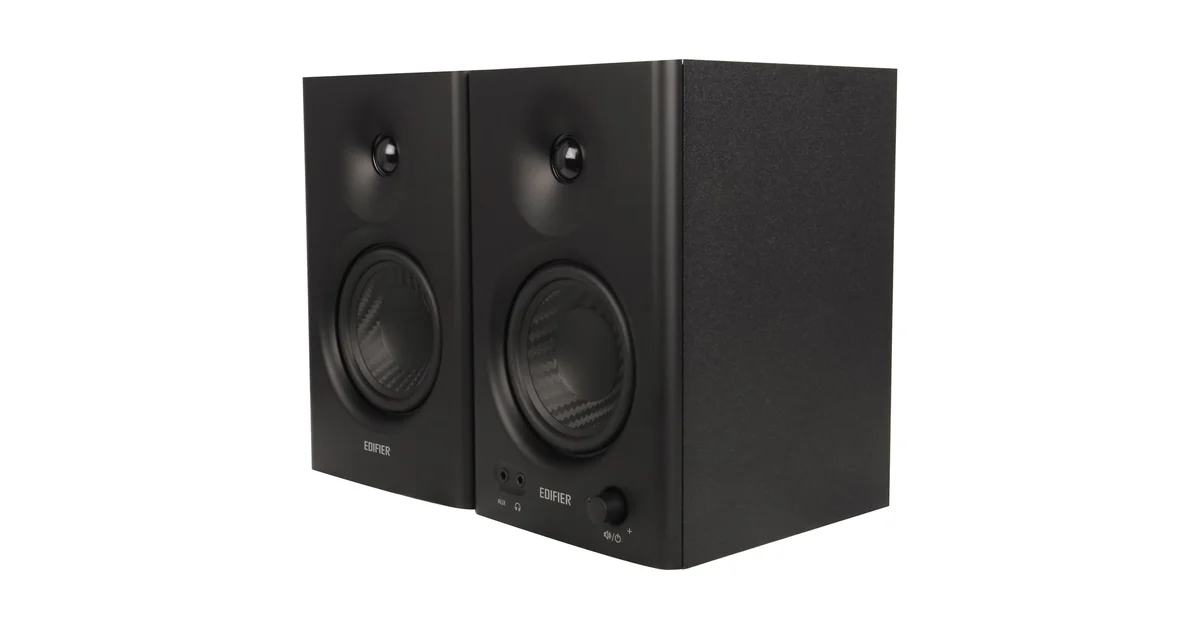
For most of my adult life my desk had the same audio setup as everyone else’s: whatever speakers came in a bundle, or a pair of plasticky 2.1 gaming things with a subwoofer that only knew how to boom. I told myself it was fine because it was “just a computer.” Then I put a pair of actual studio monitors on the desk and realized how much music I had been missing for a decade.
The Edifier MR4 is the speaker I now hand to anyone who asks how to make their desk sound good without spending real money. It is $130, it is honest, and it embarrasses every consumer desktop speaker I have owned. Six months in, this is the review.
What the MR4 Actually Is
The MR4 is a pair of powered near-field studio monitors. “Powered” means the amplifier is built in, so you do not need a separate amp like you would with passive bookshelf speakers. “Near-field” means they are tuned to be listened to from a few feet away, which is exactly the distance you sit from a desk. “Studio monitor” means they are voiced to be flat and revealing rather than bass-boosted and flattering.
Each speaker has a 4 inch woofer and a 1 inch silk dome tweeter in an MDF wood cabinet. The amplifier and all the inputs live in the right speaker, and a speaker cable runs from there to the passive left speaker. That is the standard layout for budget powered monitors, and it has one consequence worth saying out loud: the two speakers are tethered to each other, and the right one needs both power and your source signal.
On the back of that right speaker you get the part that makes the MR4 stand out at the price:
- Balanced TRS inputs. A pair of quarter inch balanced jacks. Balanced connections reject electrical noise on the cable run, which matters if your source is a USB audio interface sitting a couple feet away. At $130 this is rare.
- RCA inputs. Standard unbalanced RCA for a turntable preamp, a DAC, or a computer’s line out.
- AUX input. A 3.5mm jack on the front for plugging a phone or laptop in directly.
- Front headphone jack. Plug in headphones and the speakers mute automatically. Genuinely useful for late nights.
Three input types plus headphones covers basically every desktop source you will throw at it.
Setup and the Mode Switch
Getting them running takes about five minutes. Plug the power into the right speaker, run the included speaker cable to the left, connect your source, and you are done. I drive mine from a small USB audio interface over the balanced TRS inputs, which keeps the signal clean, but plenty of people just run RCA or AUX straight from a laptop and it sounds great.
The one control that matters is the Monitor and Music mode switch on the front. This is not marketing filler. In Monitor mode the MR4 plays it straight, with the flattest, most neutral response. This is what you want if you are mixing audio, editing video, or you simply want to hear the recording as it actually is. In Music mode the tuning adds a gentle smile-curve lift to the lows and highs, which makes casual listening a little more fun and forgiving with compressed streaming sources.
I leave mine in Monitor mode almost always, because the whole reason to buy a monitor is to hear honestly. But it is a thoughtful touch that the Music mode exists for the nights you just want the speakers to be a little more exciting, and the difference between the two is clearly audible, not a placebo.
How They Sound
Here is the part that matters. The MR4 sounds like a real speaker, not a computer accessory.
The midrange is the star. Voices, acoustic guitar, piano, and snare all come through with a clarity and presence that plastic desktop speakers simply cannot do. The first week I owned these I went back through albums I have heard hundreds of times and kept noticing background details, a doubled vocal here, a reverb tail there, that my old speakers had been smearing into mush. That is what a flat near-field monitor buys you: the recording, not an interpretation of it.
The treble from the silk dome tweeter is smooth and never harsh. Some cheap monitors get sibilant and fatiguing after an hour. The MR4 does not. I can work a full day with these on and never feel the urge to turn them down.
The honest limitation is bass. These are 4 inch woofers in a small cabinet, and physics is physics. They roll off below roughly 60Hz. That means kick drums and bass guitar are present and tight, but the lowest octave, the sub-bass rumble in electronic music or a film explosion, is not there. For most desk listening this is completely fine and arguably better, because tight accurate bass beats bloated boomy bass every time. If you genuinely want the floor to shake, you add a subwoofer, and the MR4 takes one happily off the RCA path if your source can split the signal.
What you will not hear is the muddy one-note bass and scooped midrange of consumer gaming speakers. The MR4 trades that artificial excitement for accuracy, and once your ears adjust over a few days, there is no going back.
How It Compares
The budget powered monitor space is crowded, so a few honest comparisons for the speakers people actually cross-shop against the MR4.
The most common rival is the PreSonus Eris 3.5, which sits around the same price with smaller 3.5 inch woofers. The Eris is a fine speaker, but the MR4’s larger 4 inch driver gives it more body and a little more low end, and the MDF cabinet feels more solid than the Eris enclosure. In my listening the MR4 sounds a touch clearer and less thin through the midrange, which tracks with what most people report. If the two are the same price, I take the MR4.
The other frequent comparison is the Mackie CR series, which leans more toward “multimedia speaker” than true monitor. The CR speakers are voiced warmer and more fun out of the box, which some people prefer for casual listening, but they are not as honest a reference. If you want a speaker that flatters everything, the Mackie is pleasant. If you want to actually hear your recordings, the MR4 in Monitor mode is the more useful tool, and it still has the Music mode for the nights you want fun.
Against Edifier’s own lineup, the MR4 slots below the R1280 powered bookshelf line in terms of consumer voicing but above it in honesty. The R1280 is the better pick if you want bass-forward bookshelf speakers for a living room. The MR4 is the better pick for a desk where accuracy matters. They are aimed at different jobs despite the similar price.
The short version: at $130 the MR4 is the one I would buy in this class, mostly on the strength of the balanced inputs, the solid cabinet, and the genuinely flat Monitor mode.
Pairing a Subwoofer
If the bass roll-off is the only thing holding you back, a subwoofer solves it cleanly and the MR4 plays well with one. Because the amp lives in the right speaker and takes line-level RCA in, the simplest path is to run your source into a subwoofer with high-level or line outputs, let the sub take the lowest octave, and pass the rest up to the MR4. A modest 8 inch powered sub crossed over around 80Hz fills in everything the 4 inch woofers give up and turns the desk into a genuinely full-range system.
You do not need anything expensive here. The goal is to add the bottom octave the monitors cannot reach, not to shake the room, so a small sealed sub tuned conservatively is the right call for near-field desk use. If you go this route, set the crossover by ear: turn the sub down until it disappears, then bring it up just until the low end feels whole. Done right, you stop noticing the sub entirely and just hear a bigger, fuller MR4.
Who Should Buy These
The MR4 is close to a no-brainer for a few specific people.
If you are still on the speakers that came with your monitor, a soundbar at your desk, or a pair of 2.1 gaming speakers, this is the single best $130 you can spend to upgrade your daily audio. The jump in clarity is not subtle.
If you are starting out in music production, podcasting, or video editing on a budget, the MR4 gives you a genuinely flat reference to work against for far less than the usual entry monitors. They are good enough that you can make real mixing decisions on them, with the understanding that you will want to check the low end on headphones given the bass roll-off.
If you are an audiophile who wants deep, full-range sound and floor-shaking bass at the desk, look higher up the range or plan on a subwoofer from day one. The MR4 is honest and clean, but it is not big, and that is the trade-off at this size and price.
The Small Things I Appreciate
A few details that show Edifier thought about real use. The volume knob is on the front, not hidden around the back like some monitors, so adjusting it is easy. The headphone jack muting the speakers automatically means you are not reaching behind anything at 11pm. The cabinets are real MDF and feel inert when you knock on them, with none of the hollow plastic resonance that colors the sound on cheaper speakers. And they come in black or white, so they actually fit a desk you care about the look of.
The included speaker cable is a bit short and basic, but it works, and swapping it for a longer run is trivial if your desk needs it.
The Bottom Line
The Edifier MR4 is the easiest audio recommendation I make. For $130 you get honest, near-flat studio monitor sound, real balanced TRS inputs that no competitor offers at this price, a genuinely useful dual-mode switch, and the build quality to back it up. The only thing it asks in return is patience with the bass: these are 4 inch woofers, and if you need the bottom octave you will want a subwoofer.
For the vast majority of people sitting at a desk with bundled speakers or a tinny soundbar, the MR4 is a transformation, not an incremental upgrade. It is the speaker that finally made my computer sound like a stereo, and at this price I cannot think of anything I would buy instead.