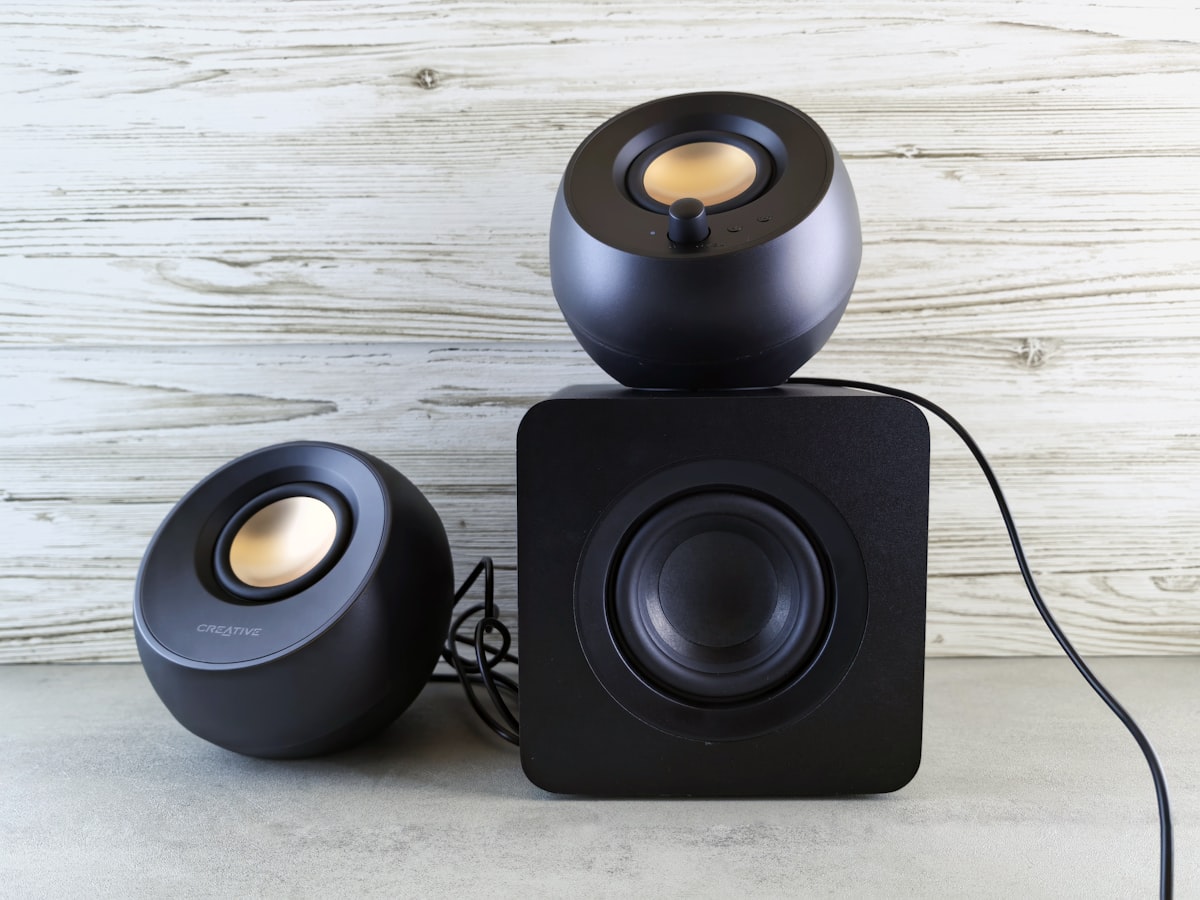
If you’ve spent any time on /r/BudgetAudiophile or in the powered-speakers aisle of any AV forum, two products keep showing up: the Audioengine A5+ and the Kanto YU6. Both are powered bookshelf speakers in the $450–$500 range. Both have phono inputs. Both are praised on basically every audio forum. And both are, in my experience, different enough that picking between them depends on what you’re going to plug into them and where they’re going to live.
I’ve spent meaningful time with both. Here’s the honest head-to-head.
The Quick Verdict
- Buy the Audioengine A5+ if you want warm, forgiving sound for a desk or small living room, you prioritize build quality and longevity, and you’re fine without a remote control or front-panel display.
- Buy the Kanto YU6 if you want a more neutral, detailed sound, you need Bluetooth and a real remote, and you want HDMI/optical inputs for a TV.
Both are great. The A5+ is the audiophile’s choice. The YU6 is the practical pick for most living rooms.
What They Have in Common
Before pulling them apart, the overlap is significant:
- Powered bookshelf speakers — amp built into one cabinet, passive cable to the other
- Built-in MM phono preamp — plug a turntable in directly
- RCA + 3.5mm analog inputs
- Subwoofer output — both pair with a sub trivially
- Roughly the same footprint — about 11” tall and 7” wide
- Similar price — A5+ ~$499, YU6 ~$449 street
If your needs are “play music from one source through some good-looking bookshelf speakers,” either one will make you happy. The differences are at the margins, but the margins are real.
Sound: Warm vs. Neutral
The Audioengine A5+ is voiced warm. Bass is generous for its size. The midrange has a pleasing bloom — vocals and acoustic guitars have body to them. Treble is rolled off slightly, which makes the speakers forgiving of harsh-sounding sources (compressed Spotify streams, older digital recordings, bright pop production). After an hour of listening you don’t get fatigued. After eight hours of background music while working, you still don’t.
The Kanto YU6 is voiced flatter. The bass is tighter and more controlled, the midrange less prominent, the treble more open. Cymbals have more shimmer. Detail in busy mixes comes through more clearly. The trade-off: bright recordings sound bright. Hi-hats on a poorly-mastered punk record will absolutely sting you.
If forced to pick a one-line summary: the A5+ sounds like a slightly tubey amp into traditional bookshelf speakers. The YU6 sounds like a clean Class D amp into a more modern monitor.
Both have real bass for their size. Neither replaces a sub if you want to feel a kick drum. With a subwoofer like the Audioengine S8 crossed over around 80 Hz, both systems become genuinely satisfying full-range setups.
Build and Aesthetics
The A5+ feels more expensive than it costs. The cabinets are solid MDF, the binding posts on the back are five-way and beefy, and the included speaker cable is decent. The matte finish (walnut, bamboo, or black) ages well. Pictures don’t do them justice — they look like furniture, not gadgets.
The YU6 feels modern. The cabinets are well-made but lighter. The finish options (matte black, matte white, gloss black/white, walnut, bamboo) skew contemporary. The front panel has a small display and physical controls. There’s a remote in the box. Bluetooth pairing is one button.
The A5+ has no display, no remote (the standard model — there’s a “wireless” A5+ with Bluetooth that costs more), and no on-unit volume control beyond a dial on the rear of the active cabinet. The minimalism is intentional and it photographs beautifully. It is also a small annoyance if you sit on a couch ten feet away and want to skip a song.
For a desktop where the speakers are within arm’s reach, this is a non-issue. For a living room where they’re across the room, the YU6’s remote matters.
Inputs and Connectivity
Here the YU6 pulls ahead, decisively.
A5+ inputs:
- RCA
- 3.5mm
- Phono (switchable with RCA via rear toggle)
YU6 inputs:
- RCA
- 3.5mm
- Phono (separate from RCA)
- Optical (TOSLINK) — useful for TVs and gaming consoles
- Bluetooth (aptX) — pair phones directly, no streamer needed
If you want one set of speakers for a turntable and a TV and a phone with no extra hardware, the YU6 is the answer. Plug everything in, pick inputs from the remote, done.
The A5+ assumes you’ll feed it from one source — typically a streamer, a turntable, or a desktop DAC — and have a separate input switcher upstream if you need multiple sources. Cleaner if you’ve already built a hi-fi system around something like a WiiM Pro Plus. Less convenient if you’re starting from zero.
The Phono Stage
Both have built-in MM phono preamps and both are fine. Not great. If you’re running a budget turntable like the Audio-Technica AT-LP60X into either one, you won’t hear a meaningful difference between the internal preamps and a $100 external box.
If you’re running a more serious deck like the AT-LP120XUSB and a $100+ cartridge, both internal preamps become the bottleneck. Run a separate phono stage like the Schiit Mani 2 in that case, into the RCA input.
Neither is better than the other here. Both are “good enough to get you started, replace later when you care.”
Desk vs. Living Room
This is the actual decision-driver for most people.
Desktop setup, you sit two to four feet away: A5+. The warmer voicing is more pleasant at near-field volumes, the minimalist look fits a desk, and the lack of remote doesn’t matter when the volume dial is sitting right next to you. The A5+ on a desk with a USB DAC and a turntable is the canonical “I’m done upgrading” near-field setup.
Living room or kitchen, you sit 8–15 feet away: YU6. You need the remote. You probably want to plug a TV in via optical. The flatter voicing scales better at higher volumes, where the A5+ can sometimes feel slightly congested. The YU6’s Bluetooth means guests can stream music without dealing with your stack.
What About the Edifier R1700BT or KEF LSX II?
Reasonable alternatives worth a mention:
- Edifier R1700BT (~$200) — half the price, two-thirds the sound. If $450 is more than you want to spend, the R1700BT is the value pick. You give up some bass extension and some build quality but you keep most of the listening experience.
- KEF LSX II (~$1,300) — three times the price. Network streaming built in, no separate streamer needed, sound quality that’s a clear step above either of these. Different league. If you can stretch the budget significantly, they’re worth looking at — but for the $450 segment, the A5+ and YU6 are still the right answers.
The Bottom Line
The Audioengine A5+ is the desk speaker. Warm, forgiving, beautifully built, easy to live with for years. Pair it with a USB DAC, point it at your face, never think about it again.
The Kanto YU6 is the living-room speaker. More inputs, a real remote, Bluetooth, a flatter voicing that scales better at distance. The Swiss army knife of powered bookshelves under $500.
You can buy either one and be happy. But buy the one that matches the room, not the one that has the better online reviews. The reviews are for both. The room is for one.