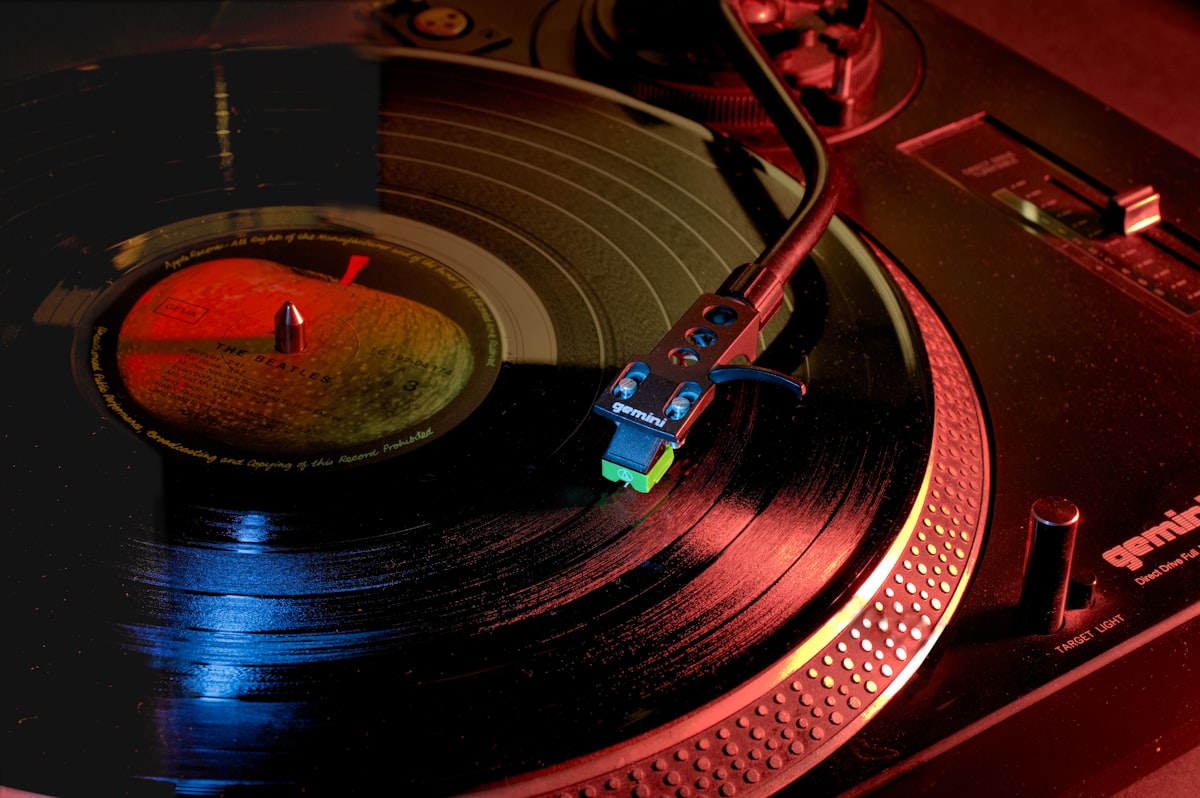
I have, at this point, recommended the Audio-Technica AT-LP120XUSB to roughly every person who has emailed this site asking how to get into vinyl. The recommendation is starting to feel suspicious by repetition. So I want to put it in a single post: why this is the turntable, what it is and is not, and where you should consider stepping past it.
This is a single-product review of a $350 turntable that has been on my main rack for years. The short version is that the AT-LP120XUSB is the most defensible default in this category. The long version is everything below.
What It Is
The AT-LP120XUSB is a direct-drive turntable with an S-shaped tonearm, an adjustable counterweight, adjustable anti-skate, a switchable internal phono preamp, a USB output for digitizing records, and a pre-installed AT-VM95E moving-magnet cartridge. It looks unmistakably like a Technics SL-1200 because that’s the lineage it descends from — same form factor, same general layout, similar idea, a fraction of the price.
Out of the box you set the counterweight, set the anti-skate, plug it into anything with an aux input (with the phono preamp switch flipped to LINE), drop the needle, and hear music. If you have a real phono stage in your amplifier or as an outboard unit, you flip the switch to PHONO and bypass the internal preamp.
This is a setup that takes ten minutes the first time and zero minutes thereafter.
Why It’s the Default
There are three categories of turntable for under $500, and the AT-LP120XUSB is the only one that does all three things well.
Belt-drive starter tables like the Audio-Technica AT-LP60X or the Fluance RT81 are simpler and cheaper. They also have non-adjustable tonearms (LP60X) or fewer features (RT81), and they don’t have the upgrade path. You buy them, you use them for two years, and you replace them when you want to do anything serious.
Real audiophile starter tables like a Pro-Ject Debut Carbon EVO are nicer in some specific ways — a carbon-fiber tonearm, a heavier platter, a more isolated motor — but they cost more, they don’t include a phono stage, they don’t include a cartridge of the same caliber as the AT-VM95E, and they don’t have USB output. You’re paying more for less.
The AT-LP120XUSB sits in the middle and does all three jobs. It’s a serious table you can grow into. It includes the things a beginner needs but doesn’t know they need (phono stage, decent cartridge). It has the adjustments an enthusiast wants (counterweight, anti-skate, pitch control). And the USB output is genuinely useful for anyone digitizing a record collection.
That combination is the entire pitch.
The AT-VM95E Cartridge
The cartridge included with the AT-LP120XUSB is the AT-VM95E. This is a serious cartridge — the same one Audio-Technica sells separately for around $80 on its own. It tracks well, it sounds clean, and it has a real upgrade path. The VM95 series shares a body across cartridges; you can swap the stylus alone to upgrade. The factory elliptical stylus on the VM95E becomes a Shibata stylus (VM95SH) for around $200, and the cartridge body stays.
That upgrade path is rare in this price bracket. Most tables ship with a cartridge that you replace entirely when you want better sound. The VM95E lets you keep the cartridge body and pay only for the stylus.
For most people, the VM95E is enough cartridge for years. I’ve been running the factory elliptical and it’s fine. Step up to the VM95SH if you become a vinyl person; skip the upgrade if you just want to play records on Sunday morning.
The Direct Drive Question
Direct drive vs. belt drive is the dumbest argument in audio. Each has tradeoffs. Direct drive has stronger torque (start-up is instant, pitch is rock-stable, you can DJ on it) at the cost of theoretically more motor noise transmitted through the platter. Belt drive isolates the motor from the platter (theoretically lower noise) at the cost of belt stretch over time and slower start-up.
In practice, a well-made direct-drive table like the AT-LP120XUSB has imperceptible motor noise into the platter. The bearing is good. The plinth is heavy enough. I have never once heard motor noise in playback. The “audiophile” argument for belt drive at this price range is mostly inherited prejudice from people whose reference point is a $40 plastic Crosley.
The practical advantage of direct drive on this specific table is that 33, 45, and 78 RPM are all available instantly via buttons. No belt to move. And the start-stop is firm enough to cue records consistently. If you’re someone who plays one record cover-to-cover, this doesn’t matter. If you’re someone who plays a single track and switches, it does.
What I’d Actually Pair It With
The AT-LP120XUSB’s internal phono stage is fine. It is not amazing. For the first year you have the table, leave the switch on LINE and run it into whatever amp you have. Don’t agonize about it.
When you’re ready to upgrade the sound: bypass the internal preamp (switch to PHONO) and run it into a real outboard phono stage. The Schiit Mani 2 (~$150) is the canonical recommendation here. Built in Texas, four gain settings, well-engineered, transparent. It’s a meaningful upgrade and it’s the single best $150 you can spend on this setup.
For speakers, the easiest path is powered speakers like the Audioengine A5+ (~$500/pair). Plug the AT-LP120XUSB straight into them (phono switch on LINE) and you’re done — no amp required.
For a step up, run a WiiM Amp ($299) into a pair of ELAC Debut 3.0 DB63s ($280) and feed the turntable in via the WiiM’s RCA input. About $930 total for a full setup that sounds genuinely great and is fully streaming-capable for everything else you listen to. I wrote about the DB63s here and the ELAC vs Q Acoustics comparison here.
What’s Actually Annoying
It’s not a perfect table. The honest list of things that bug me:
- The mat is thin and slippery. Replace it with a cork mat or a heavier rubber mat. $15 fix. Does not affect sound much, just feels nicer.
- The dust cover hinges are mediocre. They work, but they’re not as stiff as I’d like. After a few years they’ll loosen. Some people remove the dust cover entirely; I keep mine on.
- The internal phono stage is the weakest link. Fine for starting out. Replace it within a year if you care.
- The pitch slider is delicate. If you’re not a DJ, leave it at zero forever. I have, once or twice, accidentally bumped mine and wondered for a full song why everything sounded slightly off.
That’s the entire list. None of it is a dealbreaker; all of it is the kind of thing you’d expect on a $350 turntable.
When To Skip It
There are two reasons to skip the AT-LP120XUSB.
You want a play-and-forget setup with no adjustments. Buy the Fluance RT81 ($249) or the AT-LP60X ($179). They’re simpler. They don’t have pitch sliders or adjustable counterweights. You will outgrow them in 2-3 years, but for some people that’s fine.
You’re a serious vinyl person already. Skip to the Pro-Ject Debut Pro or a Rega Planar 3. You don’t need a built-in phono stage, you don’t need USB, you do need a better tonearm and a better platter, and you’re willing to pay for them. Different tier, different category.
For the 90% in the middle — someone who wants a real turntable, who isn’t sure how serious they’ll get with vinyl but doesn’t want to buy disposable gear, who values the option to grow into a serious setup later — the AT-LP120XUSB is the answer. Has been for years. Probably will be for several more.
The Verdict
The Audio-Technica AT-LP120XUSB is the most defensible default in its category. It is not the best turntable at any price. It is the best turntable for the specific job of “I want to take vinyl seriously without committing to it forever.” It costs $350, it includes a cartridge worth $80, it includes a phono stage worth $50, it has a USB output worth nothing to most people and a lot to a few, and it has the option to grow into a serious setup later through a Schiit Mani 2 and a stylus upgrade.
There is no other table at this price that gets all of those things right.
Buy it. Get the cork mat. Leave the pitch slider alone. Enjoy the records.