At a Glance
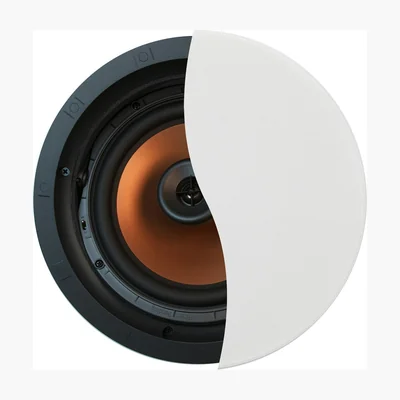
In-ceiling speakers are showing up again on Amazon’s frequently updated home-audio and architectural-speaker bestseller lists.[1][2] I understand why. Wireless speakers made multi-room audio easy, but a passive speaker in the ceiling still wins on the things I care about after the novelty wears off: no firmware, no cloud account, no power cord in every room, and no little plastic box occupying a counter.
The hard part is that ceiling speakers all look nearly identical once the grille goes on. The meaningful differences are behind the paintable circle: driver size, tweeter direction, moisture resistance, mounting depth, sensitivity, and whether the box contains one speaker or a pair.
These are the four models I would shortlist for a wired whole house audio system in 2026. I am not pretending I performed a perfectly level-matched laboratory shootout in the same ceiling. I chose them from manufacturer specifications, current availability, value, and the practical demands of rooms I actually wire. The result is a recommendation by job, not a fake universal ranking.
The Short Version
Buy the Micca M-8C when you need to cover many ordinary rooms without turning speaker cost into the biggest line item. Buy the Polk Audio RC80i for kitchens, bathrooms, and covered porches where moisture resistance matters. The Yamaha NS-IC800 is my balanced music-first pick. The Klipsch CDT-5800-C II is the premium choice when the speaker must sit off-axis from the listening area and you want to aim both treble and midbass.
I would not buy one expensive model for every room. A hallway playing quiet background music does not need the same speaker as the kitchen where everyone gathers. Spend on the important zones, use value speakers in secondary rooms, and keep impedance and sensitivity reasonably consistent within each amplifier zone.
Why I Prefer 8-Inch Speakers for Wired Zones
A ceiling speaker has no cabinet in the usual sense. It uses the ceiling cavity as part of its acoustic environment, so low-frequency performance varies with construction, insulation, and whether you add an enclosure. Still, driver area matters. An 8-inch woofer generally moves more air than a 6.5-inch one and gives background music more body without forcing a subwoofer into every room.
That does not mean an 8-inch driver is automatically better. It needs a larger cutout, and mounting depth can become the deciding spec under a shallow joist bay, duct, pipe, or layer of blocking. Measure before ordering. Compare the required drywall cutout and depth behind the finished ceiling, not the grille diameter.
I also care about tweeter direction. High frequencies are more directional than bass. A pivoting or swiveling tweeter lets you aim detail toward the part of the room where people actually sit instead of firing straight down into a coffee table. Klipsch takes this further by letting the woofer assembly pivot too. That is useful, but it costs real money.
Best Budget Pick: Micca M-8C
The Micca M-8C is the rational bulk-buy speaker. Micca uses an 8-inch mica-filled polypropylene woofer, a pivoting 1-inch silk-dome tweeter, an 8-ohm nominal load, 90 dB sensitivity, and a shallow 3.6-inch mounting depth.[3] Those are unusually practical specifications for a speaker that sells around the price of a decent dinner.
Its biggest strength is multiplication. One $60 speaker is not a big decision. Eight speakers across four rooms are. The M-8C lets you wire a kitchen, dining room, hallway, and office without spending premium-speaker money in zones that mostly play playlists, podcasts, and announcements.
The tradeoff is refinement and room suitability. Micca does not position the M-8C as the damp-location specialist in this group, and the basic spring terminals and trim are built to a price. I would use it in dry interior rooms and save the Polk for bathrooms or covered outdoor areas. Also note that Micca sells it individually, not as a pair. That is convenient for odd layouts but easy to miss when comparing prices.
The 9.4-inch cutout is another reason to measure twice. The shallow depth helps when vertical clearance is limited, but the wide hole is permanent. I trace the included template only after using a stud finder and a small inspection hole to confirm the cavity is actually clear.
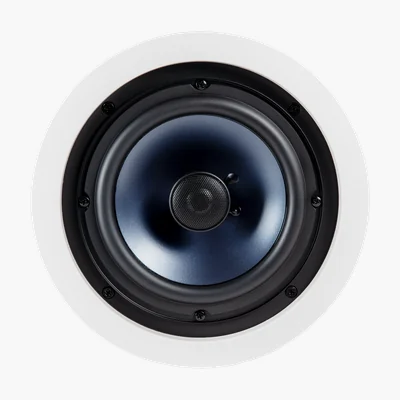
Best for Kitchens and Bathrooms: Polk Audio RC80i
The Polk Audio RC80i is the one I would choose when a room creates steam, humidity, or temperature swings. Polk uses an 8-inch Dynamic Balance woofer, a 1-inch swivel-mount tweeter, and moisture-resistant materials intended for kitchens, bathrooms, saunas, and covered porches.[4]
Polk’s “covered” qualification matters. Moisture resistant is not the same as waterproof. I would not mount one inside a shower spray zone or where wind-driven rain reaches the grille. For a normal bathroom ceiling away from direct water, it fits the job better than a generic architectural speaker whose product page never mentions humidity.
Polk sells the RC80i as a pair, so compare its price against two Miccas rather than one. The cost gap becomes smaller once quantities match. The aimable tweeter is useful in a kitchen where speakers often land wherever the joists allow, not exactly over the listening position.
The RC80i is also a safe choice for mixed-use rooms. It has enough driver area for music, a grille that disappears after paint, and a long-running product line with replacement availability. Its ordinary, proven design is exactly why I like it for a speaker that may live behind drywall for fifteen years.
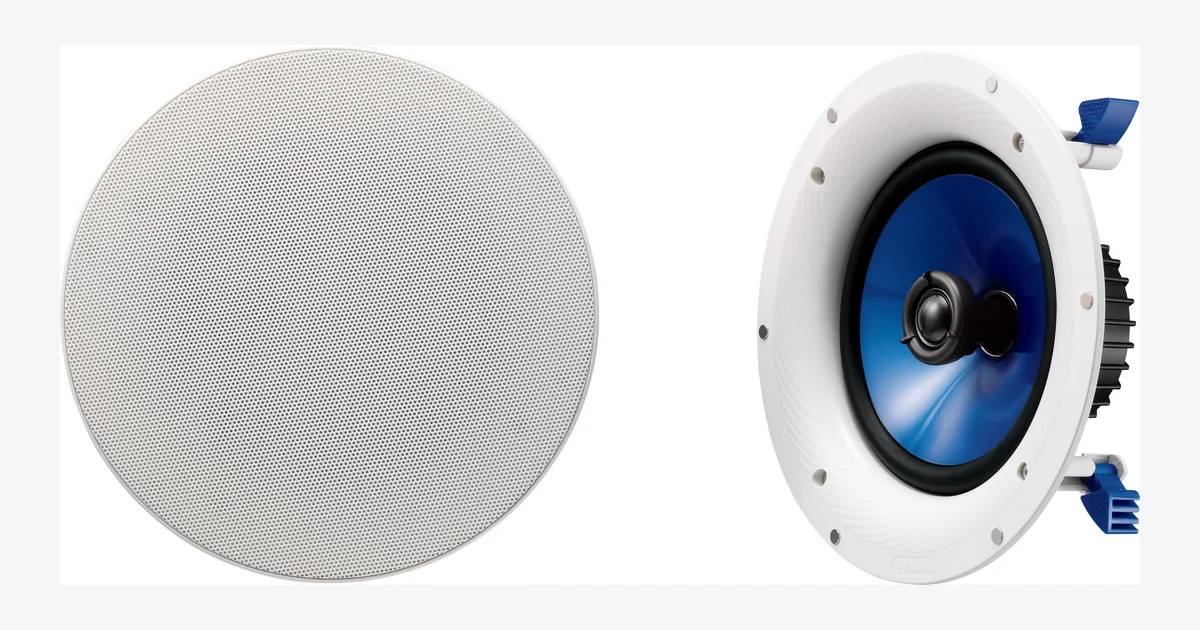
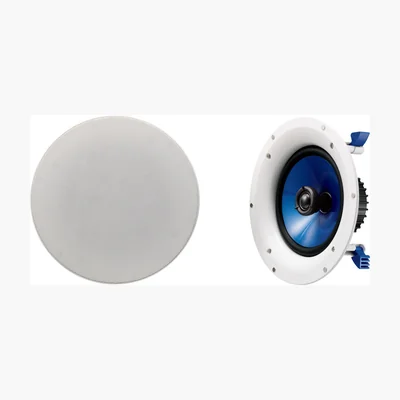
Best All-Around Music Pick: Yamaha NS-IC800
The Yamaha NS-IC800 is the balanced middle of this list. Yamaha specifies an 8-inch polypropylene mica-cone woofer, a fluid-cooled 1-inch soft-dome swivel tweeter, 90 dB sensitivity, an 8-ohm impedance, and a 50 Hz to 28 kHz frequency response.[5]
Specifications do not tell you exactly how a speaker sounds in a real ceiling, but they do expose the design priorities. Yamaha gives the NS-IC800 a large woofer, a directional tweeter, magnetic paintable grille, and a protective rear cover. Nothing is optimized for one narrow use. It is the model I would put in a kitchen, family room, or office where music matters more than filling silence.
The pair packaging makes planning straightforward. One box covers one stereo room. Its 4.25-inch mounting depth is still manageable, but it is deeper than the Micca. That extra three quarters of an inch is enough to collide with a pipe or furring strip, so do not assume all 8-inch ceiling speakers fit the same cavity.
Yamaha calls the woofer moisture resistant and protects the rear of the driver and crossover from dust and moisture.[5] I still give Polk the bathroom win because damp-location use is central to the RC80i’s pitch. For a normal dry room, I prefer Yamaha’s music-first balance.
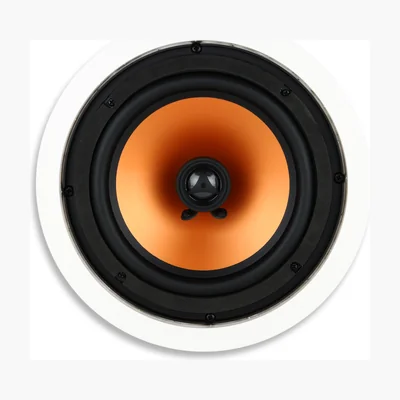
Best Premium Directional Pick: Klipsch CDT-5800-C II
The Klipsch CDT-5800-C II is the choice for a difficult room, not the default speaker to scatter through hallways. Its 8-inch Cerametallic woofer can rotate and pivot, while the 1-inch titanium compression driver sits in a swiveling Tractrix horn. Klipsch also includes treble and midbass attenuation switches.[6]
That control solves a real architectural problem. Ceiling locations are dictated by joists, lights, HVAC registers, fans, and cabinetry. The ideal acoustic point may be unavailable. A normal aimable tweeter lets you redirect the top end, but the midrange still fires straight down. Klipsch lets you steer more of the spectrum toward the seating area.
The 95 dB sensitivity is useful with a modest amplifier, but do not read it as free volume. This is a premium single speaker, and a stereo room needs two. It is also 5.4 inches deep, the most demanding cavity in this group. The feature that makes it acoustically flexible makes the installation less flexible.
I would spend this money in a main living area with awkward speaker positions, or for height channels where controlled direction matters. I would not pay the premium for a laundry room, hallway, or a bathroom playing news at low volume. Good system design is partly knowing where not to overspend.
Step 0: Check the Ceiling Before Buying Anything
A round white grille encourages wishful thinking. Do not order speakers until you know the physical cavity. Use a stud finder to map joists, then inspect for pipes, electrical cable, HVAC ducts, recessed lights, blocking, and insulation. Speaker magnets and mounting clamps need clear space beyond the cutout itself.
Check four numbers for every model:
- Cutout diameter. This is the hole, not the outside trim.
- Mounting depth. Leave extra room for terminals and the wire bend.
- Overall diameter. The grille must clear lights, trim, and ceiling edges.
- Quantity per box. Micca and Klipsch are sold individually. Polk and Yamaha are commonly sold as pairs.
Use the cardboard template that comes with the exact speaker. Do not cut from a dimension copied out of a marketplace title. Product variants and revisions can change, and drywall is a terrible place to discover that two listings used different measurements.
If the ceiling is insulated, follow the speaker maker’s clearance guidance and local code. An open-back speaker should not simply compress insulation against the cone and crossover. A purpose-built enclosure or protective cover can keep debris away, make bass more predictable, and reduce some sound leakage into the room above.
Match the Amplifier and Wiring to the Zone
All four speakers here are passive 8-ohm designs. That makes them easy partners for a WiiM Amp, Sonos Amp, conventional receiver, or a purpose-built multi-zone amplifier. The speaker wire runs from the amplifier to each speaker. WiFi reaches the streaming box, not the ceiling.
For one important room, I use a stereo pair on its own amplifier zone. For background zones, a multi-channel distribution amplifier is cleaner than stacking streaming amps in a closet. If you want room-by-room sources and volume, each room needs an independently controllable zone somewhere in the chain.
Do not connect speakers in parallel until you calculate the resulting impedance and confirm the amplifier supports it. Two 8-ohm speakers in parallel present roughly a 4-ohm load. Four on one channel can fall far below what a normal consumer amplifier wants. An impedance-matching selector or a real multi-zone amp exists for a reason.
I normally pull CL2- or CL3-rated in-wall speaker cable and leave service loops at both ends. Use 16-gauge for ordinary room runs, stepping up to 14-gauge for longer distances. Label both ends before the ceiling closes. Future you will not remember which identical white cable feeds the north kitchen speaker.
For the full system decision, start with my wired versus wireless whole house audio guide. If you want a room-by-room streaming plan, my WiiM whole house audio build covers the source and amplifier side.
How Many Speakers Each Room Needs
Most normal rooms need one stereo pair. Place the speakers symmetrically around the area where people spend time, not simply at the geometric center of the ceiling. In a kitchen, that may mean centering the pair around the island and prep area. In a family room, it means aiming around seating rather than the television.
A large open floor plan may need two pairs at lower volume instead of one pair playing loudly. More evenly spaced speakers produce more consistent coverage and fewer hot spots. If two pairs share an amplifier channel, confirm the final impedance or give each pair its own channel.
Tiny rooms create the opposite problem. A narrow bathroom or hallway may not have room for a useful stereo spread. A single stereo-input ceiling speaker has two tweeters and accepts left and right channels separately, giving you both channels from one cutout. None of the four picks above is that type, so shop specifically for a dual-voice-coil or stereo-input model when one-speaker stereo is the goal.
Do not use ceiling speakers as the left and right mains for a serious television or two-channel listening system just because they are invisible. Sound anchored above your head is fine for ambient music and Atmos height effects. Dialogue and focused stereo imaging belong near ear level. Whole house audio and a main listening room solve different jobs.
What I Would Buy by Room
For four dry secondary zones, I would use eight Micca M-8C speakers and put the saved budget into a reliable multi-zone amplifier. For a kitchen and bathroom pair, I would use Polk RC80i speakers because humidity is not where I want to gamble.
For a music-heavy kitchen or family room with straightforward placement, the Yamaha NS-IC800 is my default upgrade. If joists force the speakers away from the listening area, the Klipsch CDT-5800-C II earns its premium by letting me redirect more than the tweeter.
That mixed approach is better than declaring one winner and buying twelve of it. Rooms are different. The best whole house system uses the least expensive speaker that fully solves each room without creating a future maintenance problem.
Sources
[1] https://www.amazon.com/Best-Sellers-Home-Audio-Speakers/zgbs/electronics/172563?tag=jpkio-20 | Amazon Best Sellers in Home Audio Speakers [2] https://www.amazon.com/Best-Sellers-Ceiling-In-Wall-Speakers/zgbs/electronics/12097474011?tag=jpkio-20 | Amazon Best Sellers in Ceiling and In-Wall Speakers [3] https://www.miccatron.com/micca-m-8cm-6c-in-ceiling-speaker | Micca M-8C official product page [4] https://www.polkaudio.com/en-us/product/built-in-speakers/in-ceiling/rc80i/112724-new.html | Polk Audio RC80i official product page [5] https://usa.yamaha.com/products/audio_visual/speaker_systems/ns-ic800/specs.html | Yamaha NS-IC800 official specifications [6] https://www.klipsch.com/products/cdt-5800-c-ii | Klipsch CDT-5800-C II official product page
The Bottom Line
The Micca M-8C is the value pick, especially when one project needs many speakers. The Polk Audio RC80i is the right answer for kitchens, bathrooms, and other humid spaces. The Yamaha NS-IC800 is the balanced music-first choice, while the Klipsch CDT-5800-C II earns its premium when the ceiling forces poor placement and directional control can rescue it.
Start with the ceiling, not the shopping page. Verify cutout diameter, mounting depth, joist direction, obstructions, insulation, and wire path before buying anything. Then assign speakers by room instead of forcing one model everywhere.
That is why passive ceiling speakers are still relevant while smart speakers keep changing. The streaming electronics can be replaced whenever standards and apps move on. The speaker wire and drivers stay put, quietly doing the same job for years.