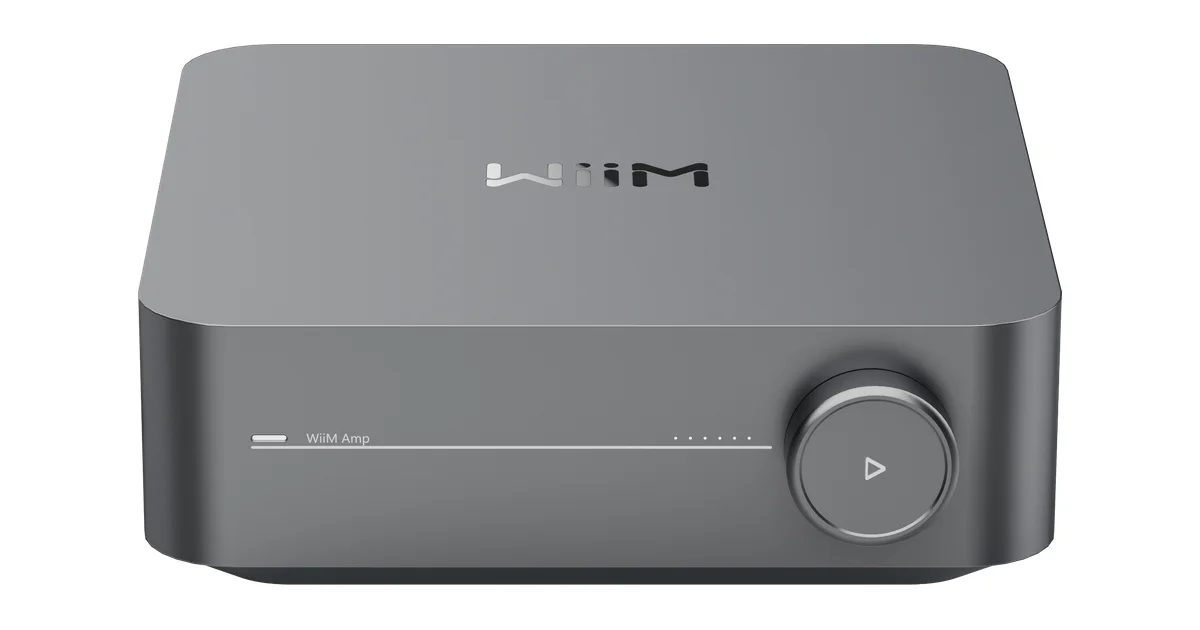
The WiiM Amp is the box that made me stop recommending AV receivers to people who just want good sound in a couple of rooms. It is a streaming integrated amplifier the size of a large sandwich, it drives a pair of passive bookshelf speakers to genuinely satisfying volume, and it pulls in every streaming service worth using without a single cloud account you have to babysit. When people ask me how to build whole-home audio without Sonos, a WiiM Amp per room is almost always where I start.
WiiM has since launched the fancier Amp Pro and the flagship Amp Ultra, and I reviewed the Ultra separately. But the original WiiM Amp is still the one I hand to most people, because it is the value node in the lineup and it does not give up much to do it. Here is the honest review after running one as a daily driver.
What the WiiM Amp actually is
The WiiM Amp packs three separate boxes into one. It is a network streamer, a DAC, and a Class D power amplifier, all in a chassis roughly the size of a paperback stack. You connect a pair of passive speakers to the binding posts on the back, plug it into your network over Wi-Fi or Ethernet, and you are playing music from your phone in about five minutes.
The amplifier section is a Texas Instruments TPA3255 Class D module rated at 60 watts per channel into 8 ohms, or up to 120 watts into 4 ohms. In plain terms, that is more than enough to drive typical bookshelf speakers to volumes that will annoy your neighbors, with clean headroom left over. Class D used to be a dirty word among audio snobs, but modern chips like this one measure beautifully and sound completely transparent in a normal room.
The DAC is an AKM chip that handles hi-res files up to 24-bit/192kHz. It is not the flagship ESS part you get in the Amp Ultra, but honestly, through passive speakers in a real room, I cannot tell the two apart in a blind comparison. The DAC is not where this box’s limits live.
The streaming side is the star. The WiiM Amp is Roon Ready and supports AirPlay 2, Google Cast, Spotify Connect, Tidal Connect, Amazon Music, Qobuz, and plain DLNA. Whatever you already use to play music, it just works, and it works at full resolution.
Setup and the RoomFit trick
Setup is the least painful part of any audio purchase I have made. Download the WiiM Home app, it finds the amp on your network, you name the room, and you are done. The app is clean and fast, which is not something I say about most audio-company software.
The feature that punches way above the price is RoomFit, WiiM’s room correction. You put your phone on the listening couch, the app plays a sweep of test tones through your speakers, measures how your room is coloring the sound, and builds a correction curve to flatten it out. Rooms do awful things to bass, and RoomFit tames the boom without you touching a graphic EQ. On a receiver, this kind of correction is the Audyssey or Dirac feature that shows up on units costing several hundred dollars more. Getting a usable version of it on a sub-$300 amp is genuinely impressive.
There is also a full parametric EQ if you want to tune by hand, plus a subwoofer output with an adjustable crossover, so you can add a powered sub and let the WiiM handle the bass management. That subwoofer out is a bigger deal than it sounds: it turns a pair of small bookshelf speakers plus a sub into a proper 2.1 system.
Connections and living with it day to day
For a box this small, the back panel is generous. You get an HDMI ARC port, which is the feature that quietly makes the WiiM Amp a soundbar replacement: plug it into your TV’s ARC port and the TV remote controls volume while your bookshelf speakers handle the audio. There is also optical in, a coaxial digital input, an analog RCA input for a turntable phono stage or another source, the subwoofer pre-out, Ethernet, and of course the speaker binding posts. Wi-Fi 6 and Bluetooth round it out.
That HDMI ARC input is worth dwelling on. A pair of real bookshelf speakers driven by the WiiM Amp will embarrass any soundbar in the same price range, and you keep the streaming and multi-room features on top. For a bedroom or a small living room, this one box plus two speakers is the whole system: TV audio, music streaming, and smart-home integration, no receiver required.
In daily use, the thing I appreciate most is that it is boring in the best way. It wakes instantly, it never drops off the network, and the app has not once made me fight it. Firmware updates arrive regularly and WiiM has a genuine track record of adding features to hardware people already own rather than reserving them for the next model. The remote is a small plastic clicker that I almost never touch because AirPlay and the app cover everything, but it is there if you want physical volume.
The one ergonomic miss versus the pricier models is the lack of a display. On the base Amp there is nothing to glance at to see what is playing or what volume you are at; you check the app. It has never bothered me, but if a front-panel readout matters to you, that is the single reason to step up to the Pro or Ultra.
Sound quality with real speakers
I ran the WiiM Amp with a pair of ELAC Debut 3.0 DB63 bookshelf speakers, which are a great match at this price. The result is exactly what you want from a good stereo setup: clean, detailed, with enough grip on the bass that the speakers sound controlled rather than sloppy. Vocals sit forward and natural, cymbals have air, and there is real stereo width when the recording has it.
The 60 watts per channel matters here. It is enough for the DB63 and most bookshelf speakers in a normal room with headroom to spare. Where it runs out is with big, inefficient floorstanders or a large open-plan space where you want concert volume. If that is you, the Amp Pro and Amp Ultra step up the power, and you should read my Amp Ultra review. For the rooms most people are actually filling with sound, though, 60 watts is plenty and I never once wished for more with the DB63.
Add a subwoofer through that sub-out and the whole thing transforms for movies and bass-heavy music. This is my standard recommendation for a small living room: WiiM Amp, a pair of good bookshelf speakers, and one powered sub. It beats any soundbar and most receiver-based systems for a fraction of the fuss.
Home Assistant and the local angle
This is the part that made the WiiM Amp click for me specifically. It exposes a clean media_player entity to Home Assistant that works entirely on your local network with no cloud round-trip. I can see what is playing, change volume, pause, and route text-to-speech announcements to it from automations. Doorbell rings, the WiiM ducks the music and speaks the alert, then resumes. Laundry finishes, it announces in the right room.
Because it speaks AirPlay 2 and Google Cast natively, it also drops into any multi-room setup you already use without locking you into a single vendor’s ecosystem the way Sonos does. One WiiM per room gives you synchronized whole-home audio that you actually own, with no monthly anything and no risk that a company bricks your speakers with a bad app update. If you want the full picture on building that out, my whole-home audio guide walks through the room-by-room approach.
WiiM Amp vs Amp Pro vs Amp Ultra
The lineup is genuinely confusing at the shelf, so here is the short version. The base WiiM Amp is the value pick: 60W, AKM DAC, no display, everything you actually need. The Amp Pro adds a better ESS DAC and a small front display for a bit more money. The Amp Ultra is the flagship with 100W per channel, a large color touchscreen, and the top-tier DAC.
My honest take: unless you specifically want the touchscreen or you are driving demanding speakers, the base Amp is the smart buy. The sound difference through normal bookshelf speakers is marginal, and the money you save buys the speakers or the subwoofer that actually change how your system sounds.
The Bottom Line
The WiiM Amp remains the streaming amplifier I recommend to most people, and the arrival of the fancier models has not changed that. It drives a pair of bookshelf speakers cleanly, RoomFit fixes your room for free, every streaming protocol is on board, and it runs fully local into Home Assistant with no cloud dependency. At its regular price, and especially when it dips under $300, nothing else gives you this much capability in a box this small.
Buy the base WiiM Amp, pair it with a good set of bookshelf speakers and maybe a sub, and you have a system that sounds excellent, stays yours, and slots straight into a local smart home. Save the flagship money for the speakers. That is where it belongs.