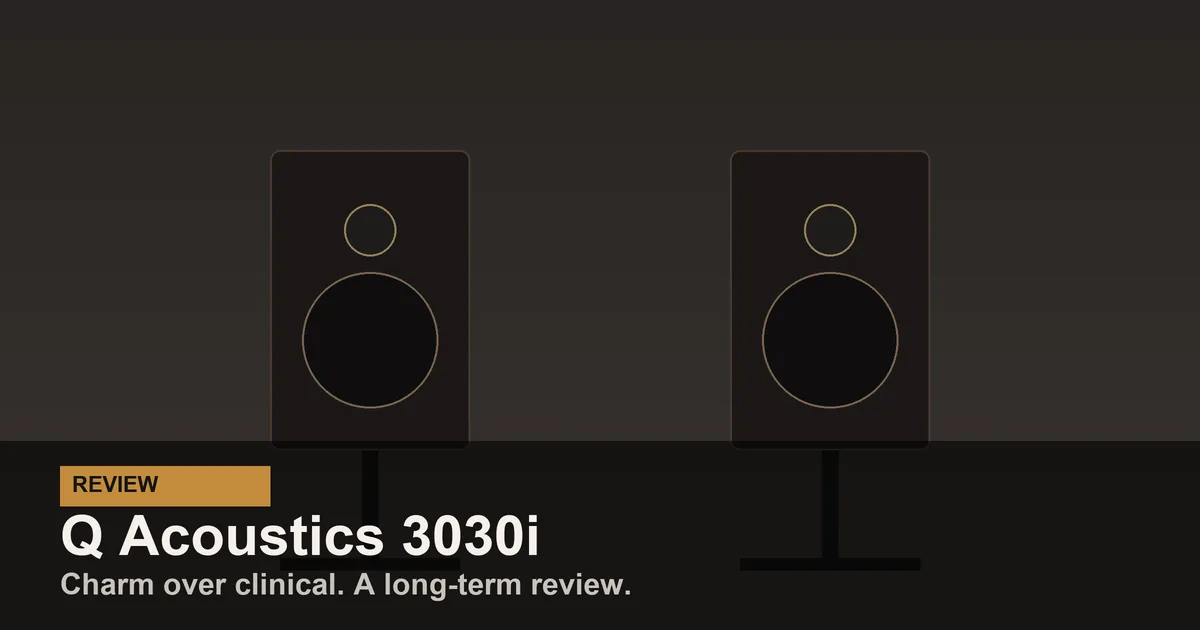
I keep two pairs of bookshelf speakers in regular rotation, and they could not be more different in personality. One is the honest, analytical type that plays exactly what is on the recording and never editorializes. The other is the Q Acoustics 3030i, and it has opinions. Warm, generous, slightly romantic opinions about how music should sound. After a year of living with them on stands in my second listening room, I have come to think those opinions are the whole point.
This is the long-term review. It is also, in a sense, the standalone version of a recommendation I have made in half a dozen roundups without ever slowing down to explain it. So here is the slow explanation: what the 3030i actually does, where it wins, where it does not, and the one placement fact that decides whether you will love it or return it.
The Short Version
The 3030i is a rear-ported two-way that trades a little bit of clinical accuracy for a lot of listenability. It throws a wide, deep soundstage, it has a warm and forgiving tonal balance that British speaker makers have been perfecting for decades, and it makes almost everything you play sound pleasant. It is not the most detailed speaker at its price, and it is fussy about placement. But when it is set up right, it is the speaker that makes you cancel your evening plans and listen to another record.
At around $400 a pair it competes in the most brutally good price bracket in all of hi-fi, and it earns its place not by winning the spec sheet but by being the most enjoyable to actually sit in front of.
Build and First Impressions
Open the box and the 3030i feels like it costs more than it does. This is Q Acoustics’ signature move, and it works. The cabinet is a real, substantial thing (25cm deep, noticeably bigger than the sub-$300 crowd) and the vinyl wrap is convincingly woodgrain in the walnut finish. You have to knock on the cabinet and look hard before you catch that it is wrap over MDF. Compared to the honestly-a-bit-plasticky finish on cheaper rivals, the 3030i looks like furniture.
The drivers are a 165mm coated paper mid/bass unit and a 22mm soft dome tweeter, decoupled from the baffle to cut cabinet coloration. The grilles attach magnetically, so there are no ugly peg holes on the baffle when you run them grille-off, which is how I listen. Binding posts are a single decent pair (no bi-wiring here, and I do not miss it). Rubber feet come pre-fitted, a nice touch if you end up shelf-mounting, though as you will see I do not recommend that.
The one thing the spec sheet tells you that matters more than any other: the port fires out the back. Circle that. We are coming back to it.
How It Sounds
Here is where the 3030i stops being a value proposition and starts being a personality.
Tonal balance. The 3030i is warm. There is a gentle lift through the midbass and a softly rolled-off top end that together produce what reviewers have called “British warmth” for forty years. It is a house sound, and it is deliberate. On rock, on acoustic singer-songwriter material, on anything with a voice and a guitar, it is gorgeous. Vocals get a little extra body and weight, the presentation leans back rather than forward, and nothing ever gets sharp or fatiguing. I have listened to these for four-hour stretches and never wanted to turn them down.
Soundstage. This is the 3030i’s headline act and where it decisively beats most of its price rivals. The stage is wide, it is deep, and it is dimensional. Singers stand well behind the plane of the speakers, instruments occupy specific and stable positions, and at their best the speakers genuinely disappear as sound sources. Close your eyes and the music is happening in the room, not coming out of two boxes. Speakers that do this trick usually cost a lot more.
Bass. Quoted in the mid-40s Hz at the bottom, and in practice the 3030i has real upper-bass authority thanks to that 165mm driver and the bigger cabinet. It sounds fuller and bigger than its footprint suggests. It is not the tightest, fastest bass I have heard (a more neutral, front-ported rival will out-punch it on electronic music where you want to hear the leading edge of each note), but for most music it is satisfying and generous rather than lean.
Treble. This is the honest trade. The tweeter is rolled off a touch at the very top, which is exactly what makes the 3030i so forgiving of bad recordings, thin streaming files, and bright rooms. The cost is a little air and a little of the last-percent detail on great recordings. If you mostly listen to compressed pop and older rock, you will never miss it and you will love how it smooths over harsh masters. If you are an audiophile who wants to hear the reverb tail decay into silence, a more analytical speaker will show you more.
Midrange. Warm and full, with vocals pushed slightly forward in body if not in position. It is a flattering midrange rather than a strictly accurate one, and I mean that as a compliment for most listeners and a caution for the detail-obsessed.
The Placement Question That Decides Everything
I cannot say this loudly enough, so I will give it its own section: the 3030i is rear-ported, and it needs room behind it.
Give these speakers stands and one to two feet of clearance from the back wall, toe them in slightly, and everything I praised above shows up. The soundstage blooms, the bass stays articulate, the whole thing sounds like a much more expensive speaker.
Shove them into a bookshelf, a built-in, or hard against the wall, and the rear port loads into the wall, the bass turns boomy and one-note, and the soundstage collapses inward. I have heard the 3030i sound mediocre, and every single time it was because someone put a rear-ported speaker somewhere a rear-ported speaker cannot live. The speaker was not the problem. The placement was.
So before you buy, ask the honest question: can you give these a real spot? If you can, they reward you enormously. If you truly cannot (apartment, tight room, must-go-on-the-shelf), buy a front-ported speaker instead and be happier. This is not a knock on the 3030i. It is physics, and it is the single most important thing to know before ordering.
What It Wants to Be Driven By
Good news: the 3030i is an easy load. It is 6 ohms with 87dB sensitivity, which means it is happy on modest power and does not need an amplifier with delusions of grandeur. Anything from about 30 watts up will do the job.
I have run mine off a WiiM Amp and they come completely alive on it. That pairing (streamer, DAC, and amp in one tidy box for around $299) is my default recommendation for these, and it makes a complete modern system for well under a grand. If you want to stretch, the WiiM Amp Ultra adds headroom, a better DAC, and onboard Room Correction, and that last feature is genuinely useful here: if you are forced to put these a little closer to a wall than ideal, room correction can claw back some of the bass bloat the rear port creates. It does not fully replace good placement, but it helps.
Feed them with decent 16 AWG speaker wire and put them on real 24 inch stands rather than furniture. The stands matter more than any cable ever will.
Who Should Buy It, and Who Should Not
Buy the 3030i if: you have a real listening spot with room behind the speakers, you value a wide immersive soundstage and a warm easy-going sound over surgical accuracy, you listen to a lot of rock, acoustic, jazz, and vocals, and you want a speaker that flatters your music and your room instead of exposing every flaw. This is a lean-back, enjoy-the-evening speaker, and it is one of the best in its price class at that job.
Skip it if: you cannot give it placement (get a front-ported speaker), you are a detail-first listener who wants the most neutral, revealing presentation possible (a more analytical rival will satisfy you more), or you mostly listen to bass-forward electronic music where speed and slam matter more than warmth and stage.
That is the honest split. The 3030i is not trying to be the most accurate speaker under $500. It is trying to be the most enjoyable, and for the right listener in the right room it succeeds completely.
The Bottom Line
The Q Acoustics 3030i is a speaker with a point of view. It is warm where clinical rivals are neutral, forgiving where they are revealing, and it throws a soundstage that punches well above its roughly $400 price. Give it stands and room to breathe and it becomes one of the most romantic, easy-to-love listens you can buy at this money. It is the speaker I put on when I want to stop analyzing and start enjoying.
It is not perfect, and it is not for the placement-constrained or the detail-obsessed. But if you have the room and you want a speaker that makes every record sound like a good decision, the Q Acoustics 3030i has earned its permanent spot in my rotation, and it will earn one in yours. Just give it the space it asks for. That is the whole deal.