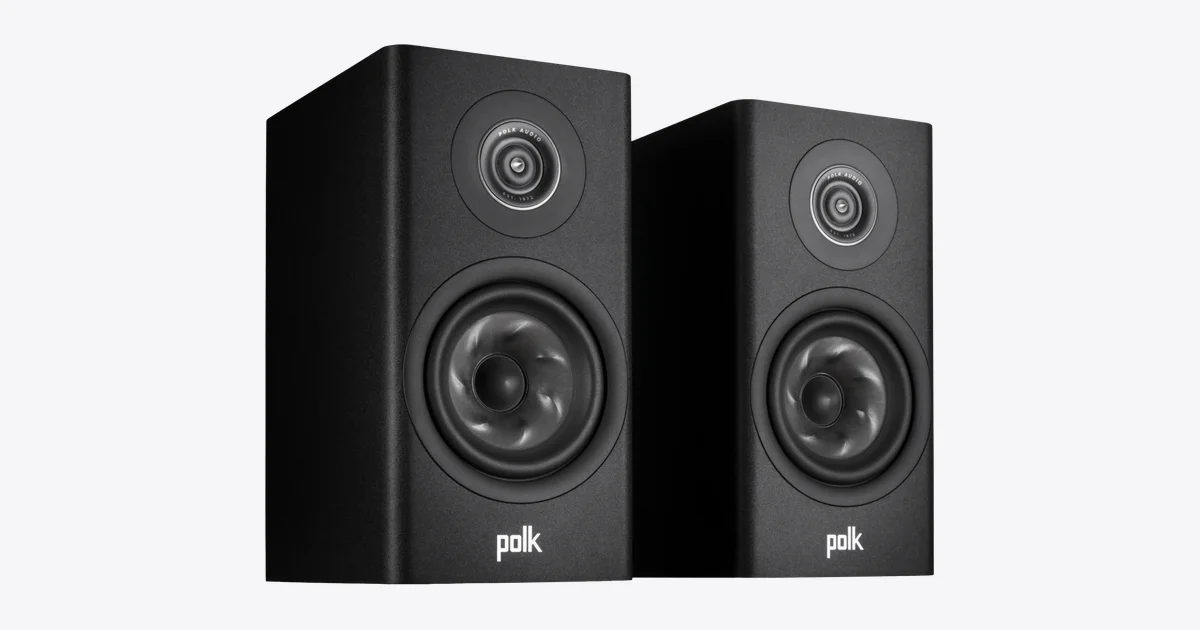
I have owned a lot of bookshelf speakers in the under-$500 bracket, and most of them are good. The market is genuinely excellent right now, and you almost cannot go wrong. So when I say the Polk Reserve R200 is the one I kept after the others went back in their boxes, I want to be clear that is a high bar to clear. These are not just good for the money. They are the speakers that made me stop swapping.
The Polk Reserve R200 sits at the top of Polk’s Reserve bookshelf line, around $500 a pair, and it has been on my stands for the better part of a year. This is the long-term review: what the fancy tweeter actually does, why the bass needs room, what amp to feed it, and who should walk past it for something cheaper.
What the R200 Actually Is
The R200 is a two-way passive bookshelf speaker, which means it needs an external amplifier and a 6.5 inch woofer handles the lows and mids while a separate tweeter handles the highs. “Passive” matters because it sets your expectations: you are buying half a system, and the amp you pair it with is not an afterthought, it is the other half.
Two pieces of Polk engineering make the Reserve line stand out from the crowd, and both are real, not marketing.
The first is the Pinnacle Ring Radiator tweeter. Instead of a plain one-inch dome, Polk uses a dome surrounded by a concentric ring, a design that smooths out the breakup modes that make cheap tweeters sound spitty and extends the response cleanly past 40kHz. The audible result is a top end that is detailed and airy but never harsh, even on bright recordings that make lesser speakers sting.
The second is the 6.5 inch Turbine Cone woofer. The cone has raised radial ribs, the turbine geometry, that stiffen it without adding much mass, so it stays rigid and moves like a piston instead of flexing. That is how a speaker this size reaches down to a genuine 40Hz, which is deeper than most of its rivals and the reason the R200 sounds fuller and bigger than its footprint suggests.
It is a substantial speaker, too. Polk calls it a bookshelf, but at over 14 inches tall and 12 deep it is a mighty bookshelf, and it will swallow a small shelf whole. Plan on stands.
Setting Them Up
Getting good sound out of the R200 takes a little more care than a small budget speaker, and it rewards the effort.
First, give them stands and space. These are 24 inch stands territory so the tweeters land near ear height when you sit. Wedging them on a desk or a low shelf throws the imaging off and traps the bass.
Second, and this is the big one, respect the rear port. The R200 is rear-ported, so it vents bass out the back, and that means it needs room to breathe behind it. Push it tight against a wall and the bass loads up and turns boomy and one-note. Pull it out at least a foot, ideally more, and the low end tightens into something taut and tuneful. If you genuinely cannot give them space, Polk includes a Power Port plug that you push into the port to tame the bass in a tight spot. It trades some low-end output for placement flexibility, and it works, but the speaker is happiest with air behind it.
Third, toe them in. Angle each speaker so it points roughly at your listening position. The Pinnacle tweeter has wide dispersion, but a little toe-in locks the center image and makes the soundstage snap into focus.
Run decent 16 AWG speaker wire to the real five-way binding posts on the back, and you are set. You do not need exotic cable, you just need enough copper for the run.
How They Sound
This is where the R200 earns its keep, so let me be specific.
The midrange is clean and uncolored, with a slightly laid-back, refined character rather than a forward in-your-face presentation. Voices sound natural and unforced, with real body to them. Where some budget speakers push the vocals at you to seem detailed, the R200 lets the singer sit properly in the mix and trusts you to lean in. After a year I still find it an easy speaker to listen to for hours without fatigue, which is the highest compliment I give a speaker.
The treble from that Pinnacle tweeter is the standout. It is detailed and extended, with genuine air and shimmer on cymbals and strings, but it never crosses into harshness. I have bright recordings that turn most speakers sibilant and edgy, and the R200 plays them with all the detail intact and none of the sting. That smoothness up top is the single biggest reason these sound more expensive than they are.
The bass is the pleasant surprise. A 6.5 inch woofer reaching a real 40Hz means kick drums land with weight, bass guitar has pitch and texture, and the speaker sounds full-range in a way most bookshelves only pretend to. It is not subwoofer-deep, the lowest sub-bass rumble is not there, but for music it is more than enough and far more satisfying than the thin, polite bass of smaller speakers. Give them the wall space they want and the low end is tight and articulate, not bloated.
Put it together and the R200 throws a wide, deep, precisely imaged soundstage that disappears into the room. Close your eyes and the speakers vanish and you are left with players arranged in space. That coherence and imaging is what separates a genuinely good speaker from a merely competent one, and the R200 has it.
The Amp They Actually Want
Here is the thing nobody tells you when you buy a $500 speaker: the R200 is somewhat power-hungry and it will expose a weak amplifier. At 87dB sensitivity with a load that dips low, it is not the kind of speaker you drive properly with a tiny lifestyle receiver or a flea-watt class-D board.
Feed it real current and it comes alive. I have run mine off a Yamaha A-S301, a $350 integrated amp that delivers a stout 60 watts a channel into 8 ohms, and the pairing is genuinely audiophile-grade for not a lot of money. The Yamaha grips the woofer, keeps the bass tight, and gives the speaker the headroom to open up at volume without strain. If you are building a system around the R200, budget for an amp of at least that caliber. A $99 mini amp will make them play, but it will not make them sing, and you will wrongly blame the speakers.
This is the trade-off of going passive. You have to buy and match the amp. The upside is the upgrade path: you can change the amp later, add a streamer, swap a source, all without replacing the speakers. The R200 is good enough to be the anchor of a system you grow into for years.
How It Compares
A few honest comparisons against the speakers people actually cross-shop.
Against the ELAC Debut 3.0 DB63, the other darling of this price bracket, the R200 is the more refined and better-imaging speaker, with a smoother top end. The ELAC is a touch warmer and more forgiving and a little easier to drive, and it is the safer pick if your amp is modest or your recordings are rough. The Polk is the more revealing, more grown-up speaker if you give it good power.
Against the Klipsch RP-600M II, it is a clear voicing choice. The Klipsch is far more efficient, with a horn-loaded, lively, in-your-face presentation that is exciting and plays loud off little power. The R200 is the more neutral, more refined, less fatiguing speaker. If you want energy and scale, Klipsch. If you want accuracy and a tweeter you can listen to all day, Polk.
Against cheaper Polk, like the Monitor XT or the older T-series, the Reserve is simply a class above in refinement, cabinet quality, and that tweeter. If your budget stretches to the R200, do not buy down the Polk line and wonder what you missed.
The short version: at $500 the R200 is the refinement and detail pick. It asks for more amp and more room than its rivals, and it pays you back with a more polished, more expensive-sounding result.
The Small Things
A year in, the details still hold up. The cabinet is properly braced and inert, with no hollow knock when you rap it. The grilles are magnetic, so there are no ugly peg holes on the baffle when you run them grille-off, which is how they sound best. The binding posts are real five-way posts that take banana plugs, spades, or bare wire. And they come in a few finishes, including a nice walnut, that look like furniture rather than a black plastic box.
These feel like a speaker built by people who cared, at a price where most of the competition is cutting corners you can see and hear.
Who Should Buy These
The R200 is for the listener who wants a genuinely refined, near-full-range bookshelf speaker and is willing to feed and place it properly. If you have or will buy a competent integrated amp, you have room to pull the speakers off the wall, and you value a smooth, detailed, fatigue-free sound over raw volume, this is close to the best $500 you can spend on speakers.
Walk past them if your amp is a tiny lifestyle unit you will not upgrade, or if your only option is to jam them tight against a wall or on a cramped shelf. In those cases a front-ported, easier-to-drive speaker will make you happier, because the R200’s strengths depend on giving it what it asks for. Buy them for the right setup and they are a giant killer. Buy them for the wrong one and you will never hear what they can do.
The Bottom Line
The Polk Reserve R200 is the most refined speaker I have heard anywhere near $500, and after a year on my stands it is the one I stopped wanting to replace. The Pinnacle Ring tweeter is smooth and detailed in a way that genuinely sounds like a more expensive speaker, the Turbine Cone woofer reaches a real 40Hz, and the imaging disappears into the room. It is a giant killer with two conditions attached: give it a real amp like the Yamaha A-S301, and give it a foot of air behind it. Meet those two terms and the R200 will outclass speakers that cost a lot more. Ignore them and you will wonder what the fuss was about. Meet them, and you will understand why I stopped shopping.