At a Glance
Walk down the toy aisle and count how many boxes have the word “educational” on them. Then look at the actual toy inside the box. Most of them are not educational. Most of them are single-purpose electronic devices that say a number when you push a button. The kid pushes the button. The toy says “three.” The kid pushes the button again. The toy says “three” again. The kid loses interest in eight minutes. The box goes in a closet and then to Goodwill.
This is the dirty secret of the educational toy market. The “educational” label is doing a lot of work, and most of what it’s doing is convincing parents that buying the toy is itself the educational act. It is not. The toy is.
I want to make a case for the opposite kind of toy. The kind that doesn’t teach anything specific, doesn’t have batteries, and doesn’t have a “right” way to play. The kind kids come back to for years instead of weeks. Call them open-ended toys, call them classic toys, call them whatever — the category is small, well-defined, and almost entirely uncontroversial among people who actually study how kids learn.
Why “Educational” Usually Means Worse
Here is the actual mechanism by which a kid learns from a toy. They encounter a thing. They form a hypothesis about how it works. They test it. They get feedback. They form a new hypothesis. Repeat. The toy is a tool for this loop — nothing more.
The kind of toy that maximizes this loop has a few properties:
- It does many different things depending on what you do with it.
- It doesn’t tell you what those things are in advance.
- Its feedback is physical, immediate, and honest. (Things fall down. Things connect. Things don’t connect.)
- It works the same way today as it did yesterday.
The kind of toy that minimizes this loop also has a few properties:
- It has one thing it does. You push the button, it does the thing.
- It tells you what to do via lights and sounds.
- Its feedback is performative — applause when you “win,” buzzing when you “lose.”
- It runs out of batteries and then it does nothing at all.
An ABC singing turtle is a button-pushing device. Twenty-six wooden blocks with letters carved into them is a tool. Both teach the alphabet. Only one of them is still useful when your kid is eight.
Rule 1: No Batteries
This is the single best filter I know. If you walk into a toy store and only consider toys without batteries, you eliminate about 80% of the bad options instantly. Not because batteries are evil — they’re not — but because a battery-powered toy is almost always doing the thinking for the kid. The kid is observing. They are not the verb in the sentence; they are the audience.
There are exceptions. A flashlight is a battery-powered toy in the technical sense and it is a magnificent thing for a small kid. But the flashlight does not perform — it just makes light. The kid decides what to do with the light. Same with a basic walkie-talkie. The toy is a tool, not a show.
When in doubt: the toy should be quiet until the kid does something to it.
Rule 2: One Toy Should Have Many Outcomes
The test I use in stores: can I think of at least ten different things a kid could do with this object? If yes, buy it. If no, walk past.
Magna-Tiles pass this test in a way few toys do. A 100-piece set is also a castle, a garage, a marble run, a domino chain, a 2D mosaic, a 3D dodecahedron, a phone holder for watching a show, and a thing you stack on top of yourself when you lie on the floor. Different kid, different day, different build. The same box is still in heavy rotation here three years after we opened it.
LEGO Classic — and I specifically mean the Classic line, not the licensed sets that are sculpture kits with a fixed end state — passes the same test. So do plain wooden blocks. So does a wagon. So does a roll of masking tape (genuinely — try it sometime).
The licensed LEGO sets are not bad toys. But they are kits, not blocks. A kit gets built once, displayed for a week, then either becomes part of the parts pool or breaks and gets thrown out in pieces. If you’re buying LEGO for open-ended play, buy a tub. If you’re buying LEGO as a project — like a Lego model rocket for a Saturday afternoon — buy the kit and don’t pretend it’s the same thing.
Rule 3: It Should Still Be Useful at Three Different Ages
This is the killer test. A great open-ended toy is a different toy at age 3, at age 6, and at age 9.
At 3, blocks are stacking and knocking over. At 6, blocks are houses and ramps. At 9, blocks are bridges with load-bearing requirements, or pieces in a more elaborate imaginary game.
At 3, Magna-Tiles are color recognition and “look, a tower.” At 6, Magna-Tiles are castles with rooms. At 9, Magna-Tiles are structural problems — “how do I make a roof that doesn’t fall.”
At 3, the singing alphabet turtle says “A.” At 6, the kid has long since outgrown it. At 9, it is in a landfill.
The cost-per-year-of-use math on open-ended toys is absurdly good. A $50 Magna-Tiles set used heavily for six years is $8 a year. A $30 educational toy used for two months is $180 a year. We act like the second one is the smart purchase because the sticker price is lower. It is the opposite.
What I Actually Buy
The list is short. This is most of it.
-
A tub of wooden blocks. The unpainted kind. They are good from 18 months to 10. They are good for two kids playing together. They are good for one kid alone. They are good for stacking, sorting, knocking down, building cities, building castles, lining up like dominoes, becoming food in pretend kitchens, and a hundred other things.
-
Magna-Tiles or a knockoff. The clear-colored ones look gorgeous against a window. The knockoff PicassoTiles are about half the price and the magnets are slightly weaker but still fine. Get 100 pieces, not 32. Thirty-two pieces is a frustrating amount; 100 pieces is a kingdom.
-
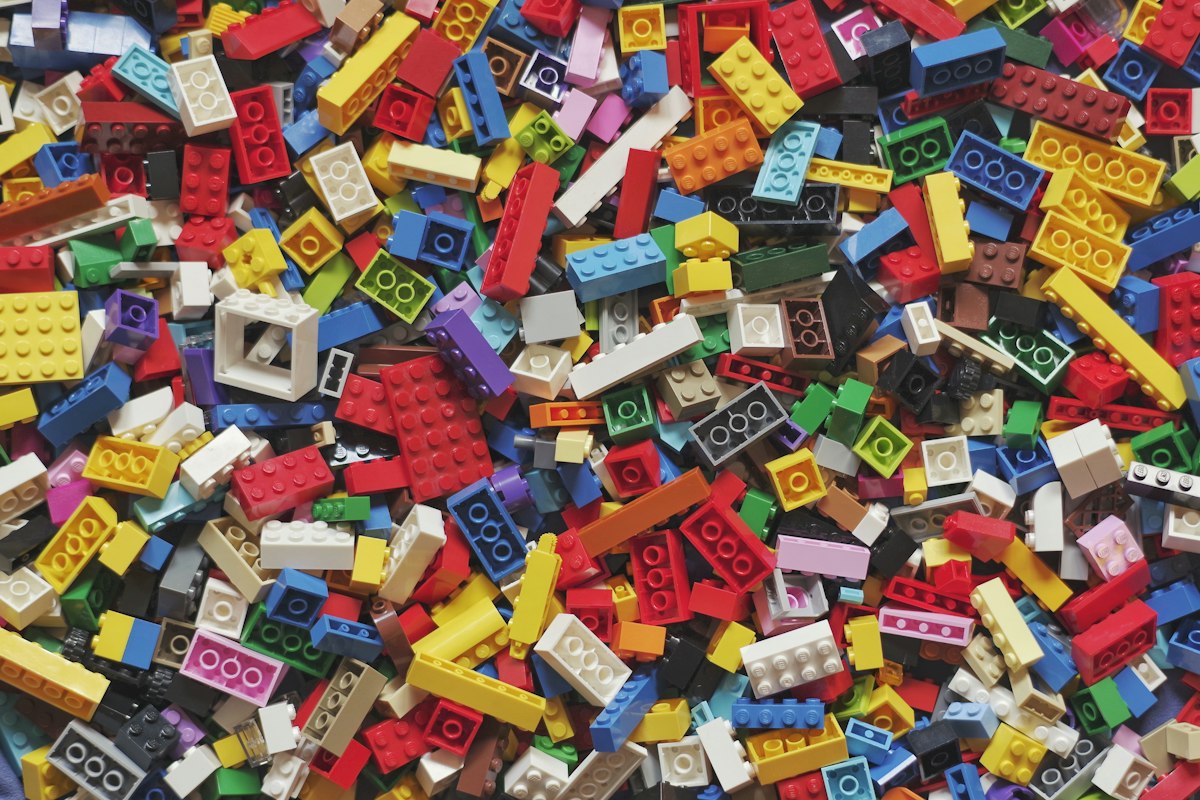
LEGO Classic large brick box. Bricks, baseplates, a few wheels, a few windows. No instructions worth following. This is the toy; the kits are a separate thing.
-
Art supplies on a shelf the kid can reach. Paper, crayons, markers, tape, glue, scissors, cardboard, string. Not a “craft kit.” Just the supplies, accessible. A craft kit produces one craft; a shelf of supplies produces a year of crafts.
-
A small set of plain figures and animals. Schleich figurines are nice, but plain wooden ones work too. These get used for imaginary play in worlds the kid builds with everything else on this list.
That’s it. That’s most of the toy budget. The rest is books, balls, sidewalk chalk, and the occasional kit-project for a Saturday afternoon.
The Honest Caveat
Open-ended toys have a real cost. They demand more from a parent — sometimes you need to sit on the floor and start building before a kid will join. They demand more from the kid — there’s no “win condition” to chase, no obvious feedback loop, no skinner-box reward. There’s a real reason that battery-powered light-up toys exist: they entertain a small kid with zero effort from anyone. If what you need on a particular Tuesday evening is for a kid to be quietly entertained while you cook dinner, an open-ended toy may not be the answer. A book or a Yoto Player will work better.
I’m not making a “screens bad, blocks good” argument. I’m making a much narrower one: of the toys you buy on purpose, fewer educational gadgets and more open-ended ones. The shelf space is finite. The hours of play per dollar are not even close.
The One-Sentence Test
Before buying any toy, ask: will my kid still be using this in three years?
If yes, buy it. If no, don’t. Most of the toy aisle fails this test, and most of the toys in your house that fail it are going to a thrift store within twelve months anyway. Skip the round trip. Buy the boring wooden blocks. They’ll outlast the singing turtle, your patience for assembling things, and probably the marriage of the person who designed the singing turtle.
Open-ended toys are not a flex. They’re just what works.